


October 10, 2026
For retail shelf impact, choose preprinted stand-up pouches. For event giveaways and sampling, cello bags with sticker branding are faster and cheaper. For corporate gifting, printed tins or custom boxes do the heavy lifting. Whichever format fits your brief, request a quote with your artwork and quantity ready, since free design support and sample proofs can get you to production fast.
TL;DR:
- Compare total landed cost, including filling labor, manual labeling, setup charges, and freight; a higher pouch price can be offset by reduced packing time.
- Flexible pouches typically need about 15 business days after artwork approval, while rollstock or label formats can be ready in about 5 business days.
- Confectionery packs need a country of origin text statement, and boxes or sleeves touching unwrapped sweets must use food contact safe board, inks, and adhesives.
- Send product, net weight, dimensions, quantity, artwork, and shelf life with the quote request, then review a digital design and physical proof before production.
Table of Contents
- Packaging formats: pouches, cello bags, tins, boxes and wrappers
- Materials, barrier properties and shelf-life considerations
- Artwork and print-ready specs for confectionery packaging
- Pricing components, hidden costs and realistic lead times
- How to request a quote, check samples and accept production
- Why work with an experienced promotional supplier
- Compliance with food safety standards and packaging regulations
- Packaging sizes and quantity options for promotional events
- What actually matters in a confectionery packaging decision
- How we help: ordering, sample options and next steps
- FAQ
- Sources
Packaging formats: pouches, cello bags, tins, boxes and wrappers
The right format depends on where your confectionery lands: on a shelf, in a showbag, on a boardroom table or in someone’s pocket. Each option carries a different cost, lead time and brand impact.
- Stand-up and flat-bottom pouches: best for retail and shelf presence, with strong barrier performance against moisture and oxygen.
- Cello bags with sticker-branded windows: a low-cost route for events, trade shows and small promotional runs.
- Printed tins and metal containers: suited to premium gifting and products meant to sit on a desk or shelf well after the sweets are gone.
- Custom boxes and sleeves: work as secondary packaging, adding point-of-sale impact and a gift-ready finish.
- Individual printed wrappers and foil: the format for single-serve chocolate branding, where every piece carries the logo.
Confectionery packaging design is leaning into formats that borrow from fashion and beauty categories, turning everyday treats into giftable products that extend well past an impulse buy. A tin or sleeve that looks considered on a desk does more for brand recall than a bag that gets opened and binned in seconds. For a working example of format choice, our personalised confectionery range shows several of these formats side by side.
Materials, barrier properties and shelf-life considerations
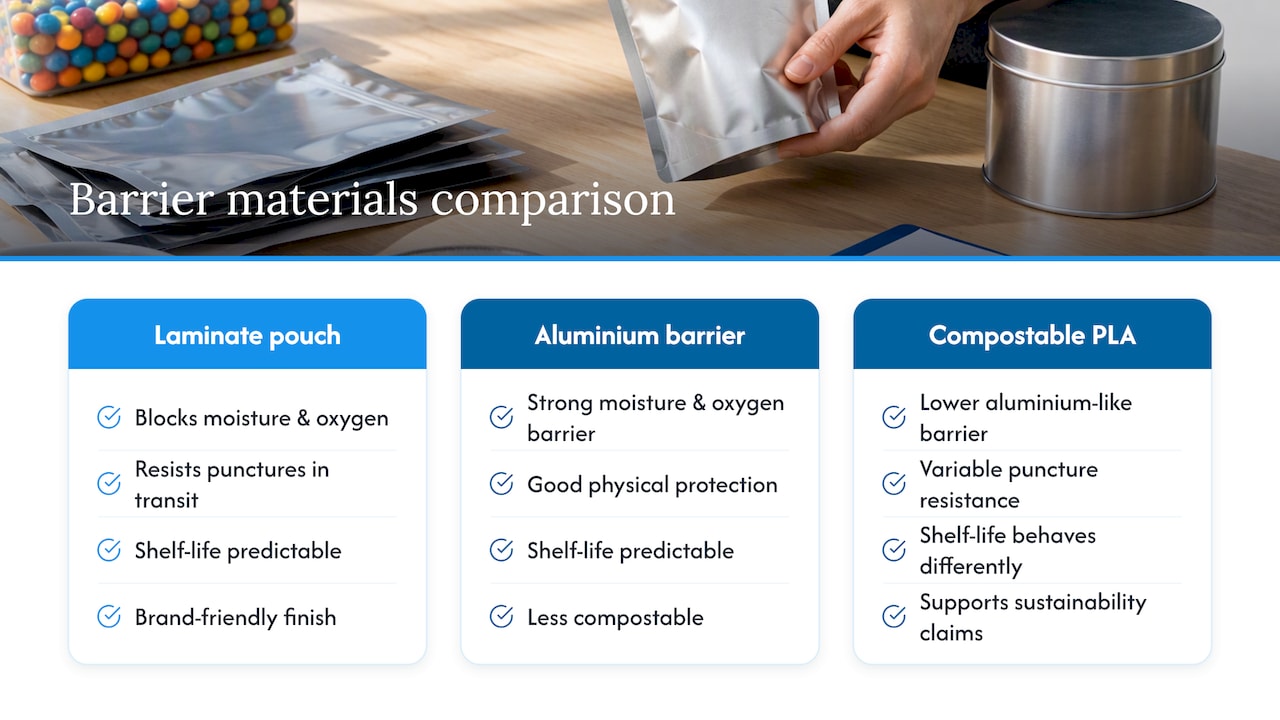
Material choice is where packaging stops being a design decision and starts being a protection decision. Confectionery needs defence against moisture, oxygen and rough handling, and the barrier layer you specify determines how long your product looks and tastes the way it should.
Flexible pouches typically use a laminate structure that blocks moisture and oxygen while resisting punctures during transit and handling. Chocolate carries an added risk: bloom, the dull grey-white film that appears when cocoa butter melts and recrystallises after warm storage or a hot courier leg. Specifying a thermal buffer layer or planning for insulated transit matters more than most marketing teams expect when stock is moving through an Australian summer.
Sustainability claims add another layer of trade-offs. Compostable and PLA-based films are appealing on brand grounds, but they can behave differently to aluminium barrier films when it comes to shelf life, which is why careful lab testing before switching formats matters before a sustainability claim goes on pack. Secondary boxes that sit in direct contact with unwrapped sweets should always specify food-contact safe board and adhesives.
Pro Tip: Ask your supplier for the barrier film’s moisture vapour transmission rate before locking in artwork, not after.
Artwork and print-ready specs for confectionery packaging
Getting artwork right the first time saves weeks. Suppliers need specific files and specific information, not a general brand guide.
- Supply print-ready files in vector format (AI, EPS or PDF) with a minimum 3mm bleed and the dieline on a separate layer.
- Convert all colours to CMYK and outline fonts before sending, so nothing shifts in production.
- Plan windows, die-cuts and multi-panel layouts early, since a pouch or box with a cut-out window needs its artwork built around that shape from the start.
- Include a country of origin text statement on the pack, since confectionery sits in the non-priority food category under ACCC labelling guidance, which means a text statement about where the product was made, packed or produced is required rather than the standard priority logo.
- Flag any custom shape, foil detail or spot varnish separately, as these add proofing steps.
We offer artwork design support as part of the ordering process, which helps keep approvals moving.
Pricing components, hidden costs and realistic lead times
Per-unit price comes down to run size, print method, substrate and finishing. A short run on rollstock will price differently to a long run of preprinted pouches, and neither price tells the whole story until you add labour.
- Run size and print method: larger quantities and simpler finishes bring the per-unit cost down.
- Substrate and barrier layer: laminated films with stronger barrier protection cost more than basic single-layer film.
- Hidden costs to budget for: manual labelling, filling labour, set-up charges and freight, all of which sit outside the headline per-unit price.
- Turnaround: rollstock and label formats can move faster, while preprinted pouches take longer because of the extra tooling involved.
Flexible pouches generally take around 15 business days after artwork approval, while rollstock options can be ready in about 5 business days. The trade-off is worth weighing carefully: a two-year pouch redevelopment by Aussie Chocolates found that switching to preprinted pouches shortened packing time significantly and landed at a comparable total cost once labour was factored in, despite a higher per-bag price. For a sense of where corporate packaging budgets typically sit, our corporate gift packaging guide breaks down per-unit ranges.
How to request a quote, check samples and accept production
A clean quote request saves back-and-forth. Send the essentials up front and build a short approval checklist before production starts.
- Provide the exact product, net weight, pack dimensions, artwork files, quantity and intended shelf life when requesting a quote.
- Ask for material spec sheets and barrier test data so you know what protection you’re actually buying.
- Request a digital mock-up first, then a physical press proof before full production begins.
- Run a brief shelf-life observation on the sample if the product will sit in warehouse or retail conditions for months.
- On arrival, check seals, print colour match against your brief and any required labelling or compliance text.
This sequence applies whether you’re ordering a short run of cello bags for an event or a full pallet of preprinted pouches for retail distribution.
Why work with an experienced promotional supplier
We’ve been sourcing and producing branded merchandise for over 25 years, which means we’ve seen most of the ways a confectionery packaging order can go sideways and built processes to avoid them. Factory-direct sourcing keeps quality consistent and pricing competitive, and free artwork design means your team isn’t chasing dielines and bleed settings on top of everything else.
We offer an express service for briefs with tight deadlines, and a Price Beat Guarantee to help you check that your quote is competitive before you commit. When hidden costs like filling labour or freight threaten to blow out a budget, we work through those numbers with you upfront rather than after the invoice lands. You can see examples of how we handle confectionery projects on our home page.
Compliance with food safety standards and packaging regulations
Confectionery packaging in Australia sits under food safety and labelling rules that apply regardless of format. Country of origin labelling is the one most marketing teams overlook, and it’s non-negotiable: confectionery falls under the non-priority food category, which means your pack needs a text statement about where the product was made, packed or produced, rather than the standard priority country-of-origin logo used on priority foods like meat or seafood. This applies whether you’re packing in a pouch, a tin or an individually wrapped bar.
Beyond labelling, any material in direct contact with unwrapped sweets needs to be food-contact safe, which covers the board, inks and adhesives used in secondary boxes and sleeves. If your product is going into export markets or retail chains with their own compliance checks, it pays to confirm requirements before your artwork is finalised rather than after a print run is sitting in a warehouse. A supplier who asks about your product’s primary packaging status when quoting is doing that check for you, which is exactly the kind of question worth expecting at the quote stage.
Packaging sizes and quantity options for promotional events
Event packaging works best when the format matches the occasion rather than defaulting to whatever size is easiest to print. A trade show giveaway calls for small, lightweight formats like mini cello bags or single-serve wrappers that attendees can pocket without thinking twice. A corporate gifting run, on the other hand, suits a tin or box format sized for a handful of pieces, something substantial enough to sit on a desk.
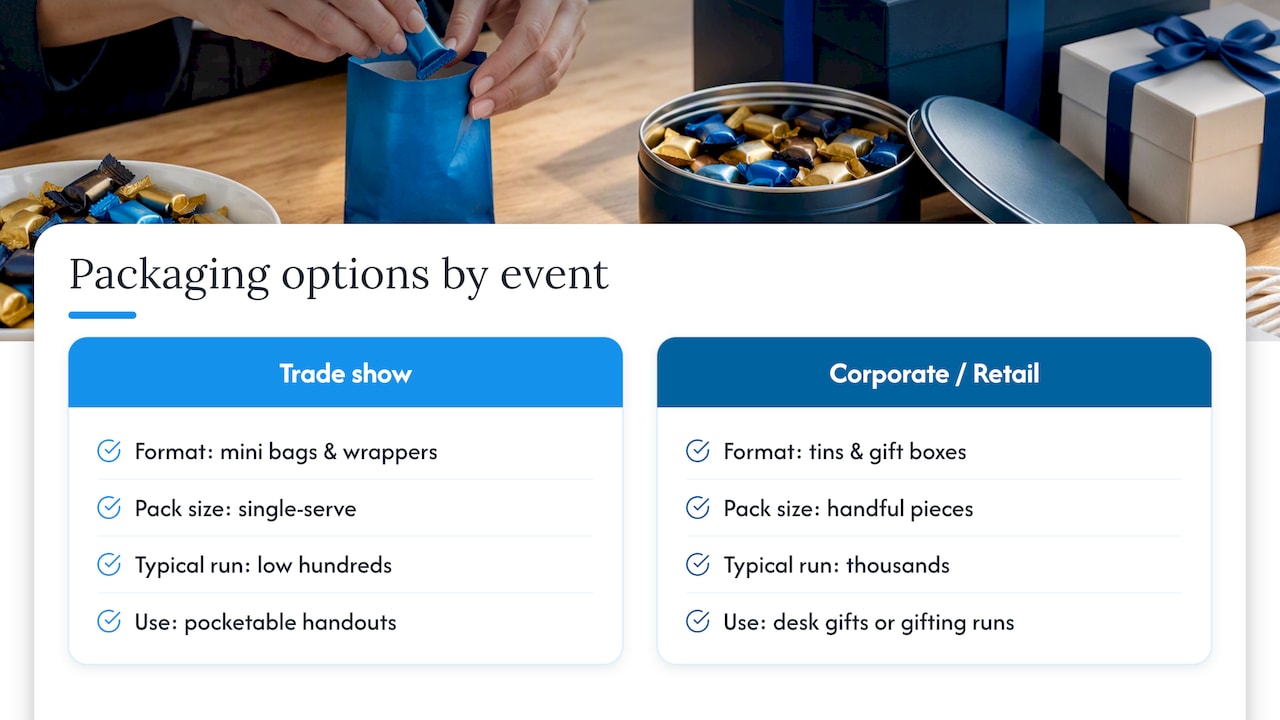
Quantity breaks matter just as much as size. Short runs in the low hundreds suit a single event or a trial launch, while retail distribution usually needs volumes in the thousands to make preprinted tooling costs worthwhile. Seasonal campaigns add their own sizing logic: a Valentine’s Day gifting run might call for a two-piece box format, while a school fundraiser or open day suits bulk bagged sweets sized for quick handouts, an approach we’ve seen work well in our education sector merchandise projects. Matching pack size and order quantity to the actual event, rather than ordering a single generic size for everything, keeps both cost and presentation on track.
What actually matters in a confectionery packaging decision
Most buying advice on this topic spends too long on finish and not enough on labour. The format that photographs best in a brief isn’t always the one that saves you money once filling and labelling labour are added up, and that distinction gets lost when teams compare per-unit quotes in isolation.
The conventional wisdom treats preprinted pouches as the premium, expensive option and cello bags as the budget pick. That’s only true if you ignore labour. A preprinted pouch with a higher per-unit cost can still land cheaper overall once you account for the hours saved on manual labelling and filling.
If you take one thing from this guide, prioritise asking for the full landed cost, materials, labour and freight together, before comparing quotes on price per unit alone. Second, treat country of origin labelling as a design input from day one, not a compliance check bolted on at the end. Get those two things right and the format choice becomes much easier to make with confidence.
— PromoShop
How we help: ordering, sample options and next steps
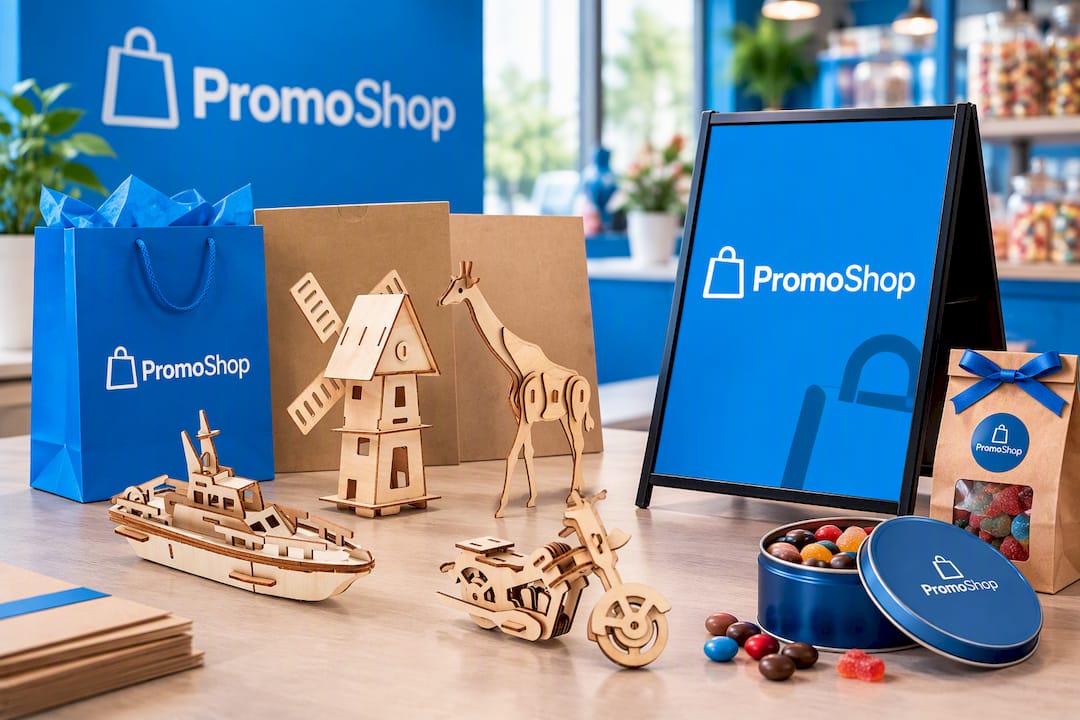
Once you’ve settled on a format, we can take you from artwork to finished product without the usual back-and-forth. Our BRANDCRAFT Custom Design Model suits brands that want a fully bespoke pack, while the BRANDCRAFT Standard Design Model is a faster route to branded packaging using proven templates. For in-store or event promotion alongside your confectionery, a Corflute Insert A-Frames Banner gives you matching signage. Request a quote, ask about samples, and our free artwork design and express service take care of the rest.
FAQ
What’s the most cost-effective packaging for a small confectionery run?
Cello bags with sticker-branded windows are generally the lowest-cost option for small runs, since they need no custom tooling. They suit events, trade shows and sampling where volume is modest and turnaround matters more than premium finish.
How long does custom confectionery packaging take to produce?
Flexible pouches typically take around 15 business days after artwork is approved, while rollstock or label formats can be ready in about 5 business days. Preprinted formats take longer because of the extra tooling involved in setting up the print run.
Do I need country of origin labelling on confectionery packaging?
Yes. Confectionery sits in the non-priority food category, which means your pack needs a text statement about where the product was made, packed or produced, rather than the standard priority country-of-origin logo.
What drives the per-unit cost of branded confectionery packaging?
Run size, print method, substrate and finishing all affect the price, along with hidden costs like filling labour, labelling and freight. A case study on preprinted pouches found that factoring in labour savings can make a higher per-unit format comparable in total landed cost to a cheaper one.
Can PromoShop help with artwork for confectionery packaging?
Yes, our free artwork design service is included as part of the ordering process, which helps you meet print-ready specifications like bleed, dielines and colour conversion without extra cost. Our express service is also available when turnaround time is tight.
Sources
- Country of origin food labelling (PDF) — ACCC
- Inside Aussie Chocolates’ two-year pouch rethink — Packaging News
- Top packaging trends in confectionery — ConfectioneryNews