


October 6, 2026
Choose durable, multi-use branded items whose sustainability claims you can verify. This approach cuts waste because a gift someone keeps and uses for years beats a trinket that lands in landfill within weeks. Before you order, check that suppliers can back their claims with real evidence, in line with ACCC guidance on environmental claims and the procurement standards your organisation follows. We stock ready options built around this exact approach.
TL;DR:
- Reusable drinkware must be made of food-safe materials, backed by a warranty, and from a verified manufacturing origin to ensure sustainability.
- Certified recycled stationery requires a specified recycled content percentage and FSC certification to meet eco-friendly standards.
- For packaging, limit to recyclable, minimal, or reusable options with clear disposal instructions and avoid mixed materials that complicate recycling.
- Sustainable gifts should be durable, have verifiable environmental claims, and include end-of-life labels like the Australasian Recycling Label.
- For each price range, select proven eco-friendly products such as recycled notebooks under $20, stainless steel bottles between $20 and $75, and artisan items above $75.
Table of Contents
- Top sustainable corporate gift categories and why they work
- How to choose sustainable corporate gifts: a procurement checklist
- Packaging and end-of-life: design for circularity
- Branding, longevity and recipient perception
- Practical ideas and price bands with buying notes
- Publisher perspective: our practical approach to sustainable corporate gifts
- Recommended products and how to order sustainably
- FAQ
- Sources
Top sustainable corporate gift categories and why they work
Some gift categories simply hold up better over time, and that durability is the whole point of sustainable gifting. Here’s what to look for in each, and what to ask your supplier to prove.
Reusable drinkware replaces dozens of disposable cups over its lifespan. Ask about material grade (food-safe stainless steel or BPA-free plastic), manufacturing origin and whether a warranty backs the product. A bottle that cracks after three months isn’t sustainable, no matter what the packaging says.
Reusable bags and carry items earn their keep through daily use. A Shoe Bag or a set of Resort Bag Tags works well here: both are configurable, durable items that recipients tend to keep in gym bags or on luggage for years rather than discarding after one trip.
Notebooks and recycled stationery should come with a stated recycled content percentage, not just a green cover. Ask for FSC chain-of-custody documentation if the product claims to use certified paper stock.
Ethical textiles and branded apparel carry more scrutiny than most gift categories. Look for certifications such as GOTS (organic textiles) or Ethical Clothing Australia accreditation, and ask whether the supplier offers take-back schemes or made-to-order production to avoid stockpiling unsold stock that eventually goes to waste.
Edible and local produce gifts work well when provenance is clear and packaging is kept simple. A hamper sourced from a named regional producer says more than a generic “local” label, and it avoids the packaging excess that undermines an otherwise good gift.
Care packs and multi-item kits should be built for usefulness, not novelty. A kit full of items nobody needs just multiplies the waste problem across several products instead of one.
Quick reference for category selection:
- Reusable drinkware: verify material grade, warranty and manufacturing origin.
- Reusable bags: check durability and whether branding is removable or integrated.
- Recycled stationery: confirm recycled content percentage and FSC certification.
- Ethical apparel: ask about GOTS or Ethical Clothing Australia accreditation and take-back options.
- Edible and local produce: confirm named supplier and minimal packaging.
- Care packs: design around genuine utility rather than variety for its own sake.
How to choose sustainable corporate gifts: a procurement checklist
Work through these steps before you brief a supplier or sign off on an order.
- Prioritise durability and everyday usefulness over novelty or quantity.
- Request recycled content data and ask whether it’s third-party verified.
- Insist on clear end-of-life labelling, including Australasian Recycling Label guidance where packaging is involved.
- Ask for packaging claims in writing, along with disposal instructions printed on the item or its packaging.
- Request supporting evidence: lab certificates, ARL registration, B Corp status, GOTS certification or ISO 14001 documentation.
- Compare the supplier’s answers against vague marketing language. If a claim can’t be backed by a number or a certificate, treat it as a red flag.
Watch for vague terms like “eco-friendly” or “green” used without explanation. The ACCC’s guidance on environmental claims warns that these claims mislead buyers when they aren’t substantiated, and the overall impression a claim creates matters just as much as its literal wording. If a supplier can’t answer a direct question about materials or end-of-life handling, ask again before you order.
For formal tenders or larger contracts, build sustainability clauses directly into your procurement terms. The Commonwealth Sustainable Procurement Guide provides model clauses that capture recycled-content requirements and environmental outcomes as part of value-for-money assessments, and the NSW Guide to environmentally sustainable procurement takes the same approach, prioritising full lifecycle impact over upfront cost alone.
Pro Tip: Ask suppliers for their sustainability evidence in writing before you commit to an order, not after the invoice lands.
Packaging and end-of-life: design for circularity
The gift itself might be sustainable, but packaging can undo that work if it’s an afterthought. A few principles keep packaging aligned with the product inside it.
- Choose minimal, reusable or recyclable packaging over elaborate boxes that get thrown out immediately.
- Avoid mixed-material packaging (plastic windows on cardboard boxes, for example), which confuses recycling streams and often ends up in general waste.
- Use Australasian Recycling Label guidance on the packaging itself, so recipients know exactly how to dispose of it.
- Ask suppliers about take-back or refill programmes, and specify packaging made with recycled content wherever that’s available.
APCO’s Packaging Sustainability Framework sets out a practical checklist for increasing recycled content and improving how packaging gets recovered at end-of-life, built around the 2025 National Packaging Targets. When you brief a supplier on packaging, reference that framework directly rather than leaving “eco packaging” as an open-ended request. Specific instructions get specific results.
Branding, longevity and recipient perception
How you brand a gift affects whether it gets used or binned, so treat branding decisions as part of the sustainability equation, not an afterthought.
- Keep logo placement subtle and sized for daily use. A huge logo across a water bottle makes it feel like promotional stock rather than something worth keeping.
- Be specific in your messaging. State the recycled content percentage or the material used rather than printing a vague “sustainable” tag with no detail behind it.
- Include simple care instructions on the item or its packaging to extend its working life, and a short lifecycle tip if relevant (how to recycle the bottle once it’s done, for instance).
- Save heavy branding for items genuinely built to last, and resist the urge to brand every single-use item in a kit. Quality beats quantity here.
Pro Tip: A smaller, well-placed logo on a genuinely useful item builds more goodwill than a large logo on something recipients forget within a week.
Practical ideas and price bands with buying notes
Matching sustainability goals to budget gets easier once you sort ideas by price band and know what evidence to request at each level.
- Under $20: recycled notebooks, reusable cutlery sets and small reusable items work well here. Check for Australasian Recycling Label compliance on packaging and ask for the recycled content percentage on the product itself.
- $20 to $75: stainless steel drink bottles, premium notebooks and ethically sourced apparel sit comfortably in this range. Ask for a materials specification, warranty details and whether a repair or take-back programme exists.
- Above $75: experience vouchers, premium textiles with documented take-back programmes, and artisan-made items with clear provenance suit this tier. Prioritise local suppliers and ask for a documented supply chain, not just a marketing claim.
Our eco-friendly product collection spans all three bands, and products like the Shoe Bag, Tin of Tees and Resort Bag Tags can each be configured with eco-friendlier materials or packaging on request. For buyers after locally rooted, experiential ideas at the premium end, regional photography and locally sourced gifts offer a provenance-driven option worth considering alongside physical merchandise. If you want a broader shortlist to compare against, our top 10 branded corporate gifts and top 15 eco-friendly promotional products round out the picture across price points.
Publisher perspective: our practical approach to sustainable corporate gifts
We back our eco-friendly collection with free artwork design, a price beat guarantee and express service, so sustainable choices don’t cost you time or certainty.
— PromoShop
Recommended products and how to order sustainably
A few of our catalogue items suit sustainable gifting particularly well, and each can be specified with eco-friendlier materials or packaging.
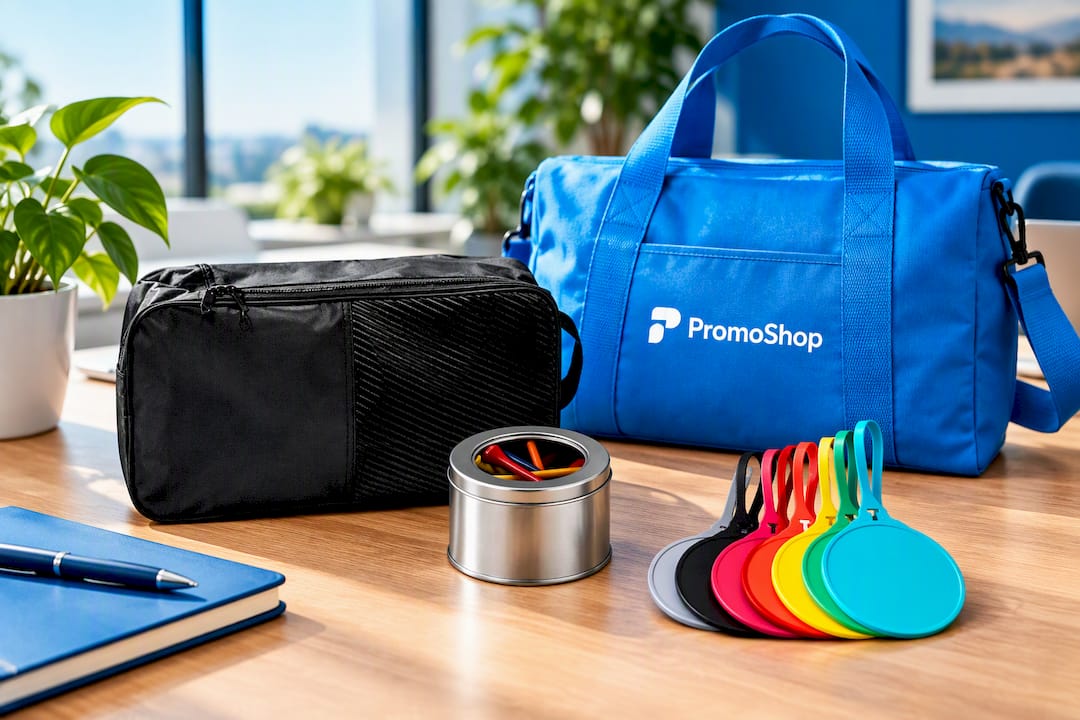
- Shoe Bag: a compact, reusable carry item recipients keep in gym bags and luggage long after the event.
- Tin of Tees: branded apparel packed in a reusable tin rather than disposable plastic, cutting packaging waste at the point of delivery.
- Resort Bag Tags: durable, reusable travel tags that keep your branding visible well beyond a single trip.
When you order, ask us about recycled-content options, Australasian Recycling Label packaging, and minimum-order sustainability choices. Our team can talk you through artwork and turnaround at the same time. Browse our full range of branded merchandise to get started.
FAQ
What makes a corporate gift genuinely sustainable?
A genuinely sustainable corporate gift is durable, gets used repeatedly, and comes with verifiable claims about its materials and end-of-life handling. The NSW Guide to environmentally sustainable procurement points to design decisions as the biggest lever on environmental impact, which is why durability and repairability matter more than a green label alone.
How do I avoid greenwashing when buying promotional products?
Ask suppliers to substantiate any environmental claim with specific numbers or certificates rather than accepting vague words like “eco” or “green”. The ACCC’s guidance on environmental claims treats unsubstantiated or vague sustainability claims as potentially misleading under consumer law.
What is the Australasian Recycling Label and why does it matter for gift packaging?
The Australasian Recycling Label tells recipients exactly how to dispose of packaging correctly, reducing contamination in recycling streams. APCO’s packaging framework recommends using the label alongside recycled-content packaging to support the National Packaging Targets.
Can PromoShop help source eco-friendly corporate gifts?
Yes, we stock an eco-friendly product collection and can configure items like the Shoe Bag, Tin of Tees and Resort Bag Tags with eco-friendlier materials or packaging on request. Ask our team about recycled-content options and ARL-labelled packaging when you place your order.
Do sustainable corporate gifts cost more than standard promotional items?
Pricing depends on the specific product, materials and order quantity rather than sustainability alone, so it varies case by case. Check with us directly for current pricing on any item in our range, including eco-friendlier configurations.
Sources
- Environmental and sustainability claims | ACCC
- The guide to environmentally sustainable procurement is now live
- Packaging sustainability framework - APCO
- Sustainable procurement - Department of Finance (Australia)