


October 7, 2026
Use pad printing for small, curved or detailed parts, and use screen printing for large, flat surfaces and high-volume runs. Both methods remain in everyday use because neither one beats the other at every job. Once you know the criteria, the choice gets a lot easier, and the checklist below walks you through it.
TL;DR:
- Pad printing is ideal for small, curved, or irregularly shaped items like pens and bottle caps, with lower setup costs and consistent throughput for mid-sized batches.
- Screen printing suits large, flat surfaces such as T-shirts and posters, offering lower per-unit costs at high volumes but with higher initial setup complexity.
- Ink durability varies: solvent-based or UV inks work well on plastics and metals, while textile inks like plastisol are best for wash-resistant fabric prints.
- Choosing the right method depends mainly on item shape, volume, and color complexity, rather than only on technical printing history or equipment.
- Always request a physical sample with your actual substrate before committing to large runs to ensure print adhesion and durability.
Table of Contents
- What is pad printing and how does it work?
- What is screen printing and how does it work?
- Head-to-head: pros, cons and practical differences
- Materials, inks and durability: what to expect
- Costs, volumes and turnaround times
- How to choose between pad printing and screen printing for your project
- Why choose PromoShop for pad or screen printed promotional products
- What actually matters when you’re choosing a print method
- Get a quote on your next print run
- FAQ
- Sources
What is pad printing and how does it work?
Pad printing moves an image from an etched plate onto an item using a soft silicone pad. The pad picks up ink from the plate, then presses it onto the surface, following the shape as it goes.
- Artwork is etched into a metal or polymer plate called a cliché.
- The silicone pad picks up ink from the cliché.
- The pad presses onto the item, transferring the image.
That flexible pad is what makes pad printing useful on curved, small or oddly shaped items where a flat screen can’t make even contact, as Xometry explains. Print area is limited, and lining up several colours takes extra passes, but run speeds are solid for small to mid-sized batches. You’ll see pad printing on pens, golf balls, electronics casings and bottle caps.
What is screen printing and how does it work?
Screen printing pushes ink through a stencilled mesh using a squeegee, depositing a layer of ink straight onto the surface below.
- Artwork is burned onto a mesh screen as a stencil.
- A squeegee drags ink across the screen and through the open areas.
- Ink sits on the surface and is cured to set it permanently.
Mesh count is the main lever here. A lower mesh count lays down a heavier deposit, which suits bold textile designs, while a higher mesh count holds finer detail and suits paper or tighter artwork, as UNSW’s screen printing resources set out. Setting up screens takes more time and equipment than a pad printing plate, but once that’s done, per-item cost drops as volume climbs. T-shirts, tote bags, posters and large flat panels are classic screen printing territory.
Head-to-head: pros, cons and practical differences
Each method earns its keep in different parts of a run. Here’s how they stack up against each other.
| Dimension | Pad printing | Screen printing |
|---|---|---|
| Best for | Small, curved or irregular items | Large, flat surfaces |
| Setup cost | Lower (cliché) | Higher (screens, mesh) |
| Cost per unit at volume | Flattens out slower | Drops sharply at scale |
| Colour capability | Limited multi-colour speed | Strong opaque colour, less photographic detail |
| Print area | Small | Large |
| Durability | Good on plastics, electronics | Good on textiles, needs curing |
| Turnaround | Fast for small runs | Slower setup, fast once running |
- A branded pen or bottle cap is a pad printing job every time.
- A stack of 500 T-shirts is almost always a screen printing job.
- A curved silicone wristband sits closer to pad printing, while a flat silicone mat leans towards screen printing, a distinction specialist printers also draw when working with silicone.
Materials, inks and durability: what to expect
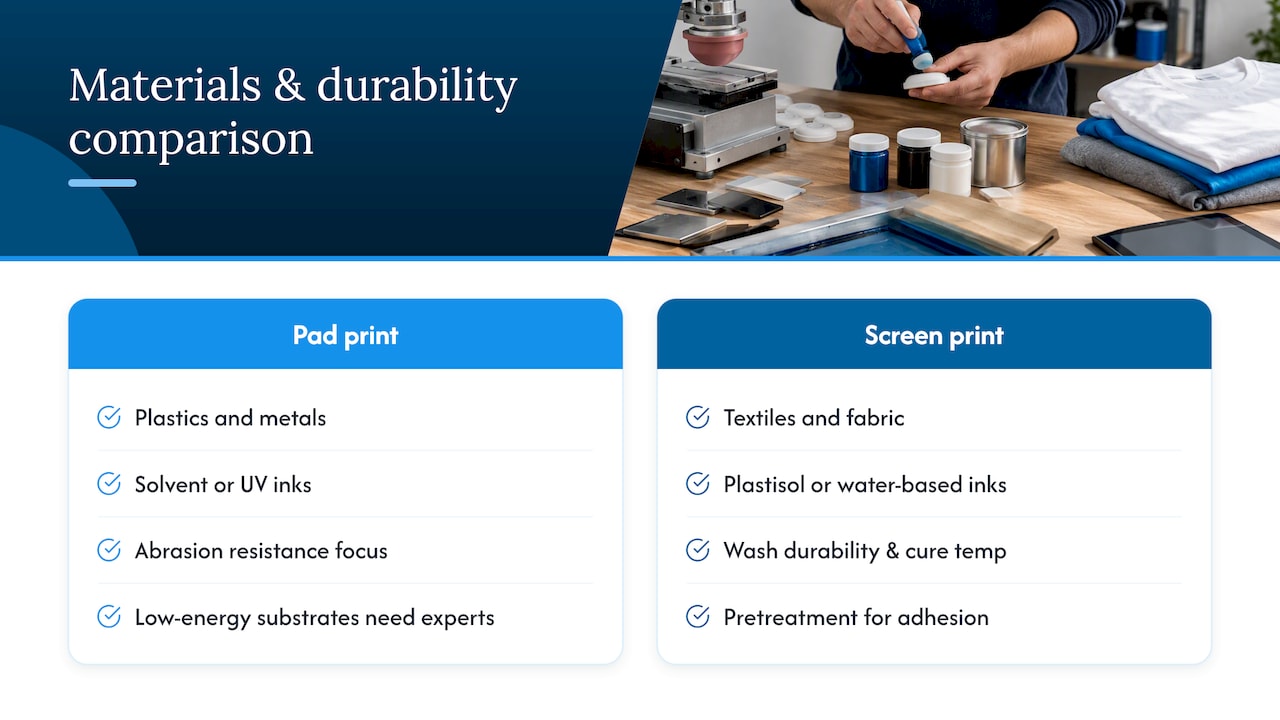
Ink choice depends on the substrate as much as the printing method. Plastics and metals typically take solvent-based or UV-cured inks for pad printing, while textiles usually take plastisol or water-based inks for screen printing, sometimes with pretreatment to help adhesion.
Durability varies by use. Textile prints need to survive repeated washing, so cure temperature and ink type matter. Plastic and electronic items need abrasion resistance instead, since they’re handled constantly rather than laundered.
Silicone, medical-grade plastics and other specialty substrates often need a specialist printer who understands adhesion on low-surface-energy materials, as outlined in guidance on printing on silicone. Academic work on screen printing for technical applications like printed electronics also shows how far the process now stretches beyond fabric, according to research published by QUT.
Pro Tip: Ask your printer for a physical sample with an adhesion test before you commit to a full run, especially on a substrate you haven’t printed on before.
Costs, volumes and turnaround times
Setup costs behave differently for each method. A pad printing cliché is generally cheaper and quicker to produce than a full screen set, which makes pad printing attractive for smaller or one-off jobs. Screen printing’s heavier setup pays off once volume climbs, because the cost spreads across more units.
- Expect per-item cost for screen printing to drop noticeably as quantity increases.
- Expect pad printing’s cost curve to flatten more gradually, suiting small to mid runs.
- Lead times stretch with colour count, cure method and how many sample rounds you need before approval.
To compare quotes properly, ask each supplier to break down tooling cost, per-unit price at your target quantity and expected turnaround for that same quantity.
How to choose between pad printing and screen printing for your project
Work through this checklist before you brief a supplier:
- Note the item’s shape: flat surfaces favour screen printing, curved or irregular ones favour pad printing.
- Measure your maximum print area and check it against each method’s limits.
- Count the colours in your design, since multi-colour artwork adds passes and cost either way.
- Estimate your run size, because volume shifts the economics towards screen printing.
- Define durability needs, such as washability for textiles or abrasion resistance for plastics.
- Set a budget that accounts for setup cost, not just per-unit price.
- Confirm your timeline, including sample approval rounds.
When you request quotes, ask about tooling costs, sample policy, cure method and how colour matching is handled. If your design includes a scannable element, size and contrast matter, and a QR label guide is worth a look before finalising artwork. For items that don’t suit either process well, digital printing, laser engraving or heat transfer can fill the gap.
Why choose PromoShop for pad or screen printed promotional products
We have experience in pad and screen printing, supported by a global supply chain and factory-direct sourcing that maintains quality and competitive pricing. Our services include artwork design assistance and competitive pricing guarantees.
Our catalogue reflects both methods in action: the RPET Microfibre Cleaning Cloth suits screen printing’s flat, high-volume strengths, while Table Top Pull Up Banners show large-format print done well. You can provide item shape, colour count, and target quantity to receive quotes and samples promptly.
What actually matters when you’re choosing a print method
Most advice on this topic gets stuck on technical history, plate etching, mesh weaves, ink chemistry, when the real decision almost always comes down to three things: shape, volume and colour count. Buyers who focus there make faster, cheaper decisions than buyers who try to become printing experts first.
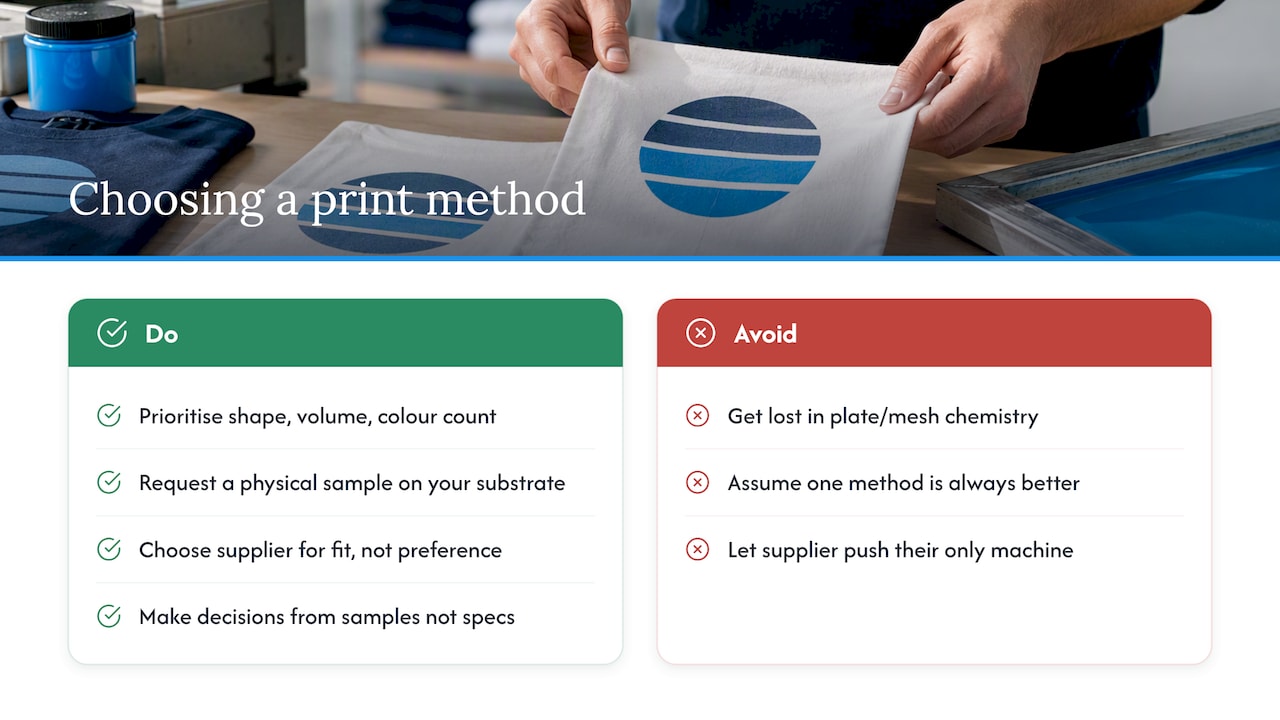
The conventional wisdom that one method is simply “better” misses the point entirely. Pad printing and screen printing solve different problems, and a supplier pushing one over the other for every job is optimising for their own equipment, not your project.
What we’d prioritise first: get a physical sample before committing to a full run, on your actual substrate, not a similar one. A proof on paper tells you little about how ink sits on curved plastic or textured silicone. The checklist matters, but a sample in hand settles arguments a spec sheet can’t.
— PromoShop
Get a quote on your next print run
We handle both pad and screen printing for promotional merchandise, and our free artwork design service helps your brief turn into a sample faster.
| Method | Best for |
|---|---|
| Pad printing | Small, curved or detailed items |
| Screen printing | Large, flat surfaces, high-volume runs |
Browse our full product range or check the Printing Options page to request a quote today.
FAQ
What are the advantages of pad printing?
Pad printing handles curved, small or irregular surfaces that flat screens can’t reach, because the silicone pad conforms to the item’s shape. It also suits lower setup needs and faster turnaround on small to mid-sized runs, as Xometry notes.
How long does pad printing last?
Durability depends on the ink and substrate, with plastics and electronics generally holding up well against everyday handling and abrasion. Items exposed to heavy wear or frequent washing should be tested with a sample first to confirm adhesion.
How expensive is pad printing?
Pricing depends on item size, colour count and quantity, so we recommend requesting a quote for your specific brief. Setup costs for a pad printing cliché are typically lower than a full screen set, which can make small runs more affordable.
Is screen printing obsolete?
No. Screen printing is still widely used for large, flat, high-volume runs, and researchers continue to apply it in technical fields like printed electronics. It remains one of the most cost-effective methods once volume climbs.
Sources
- Pad Printing vs. Screen Printing - What’s the Difference?
- Screen Printing on Paper | UNSW Making
- © The Author(s) 2023
- How to Print on Silicone: A Comprehensive Guide