
October 20, 2026
A pre-production sample is one finished item, made the way your bulk order will be made, that you check and approve before the full run starts. It uses the real material, your real logo, the real colours and the real packaging. If it is wrong, you fix it while the cost is one item. If you miss the problem, you pay for it across the whole order.
This guide explains what a pre-production sample is, how the approval process works, what to check, and what Australian rules mean for your sign-off. It is written for business owners, marketing teams and event planners who order branded merchandise.
TL;DR
- A pre-production sample is a finished example of your order, made with production materials and your artwork, approved in writing before bulk manufacturing begins.
- It is different from a prototype or a stock sample. Those test an idea or a blank product. This one tests your exact order.
- Check the logo, colours, placement, size, materials, labels, packaging and any legal wording. Write down every note.
- In Australia, you stay responsible for compliance after approval. A passed sample does not replace testing the delivered batch.
- Allow time for it. Ask early whether a sample fits your deadline.
Table of Contents
- What a pre-production sample means
- Pre-production sample vs other samples
- When a pre-production sample is worth it
- The approval process, step by step
- What to check on your sample
- What Australian rules mean for your sign-off
- Perspective: how we approach sampling
- Common mistakes at the approval stage
- Order with a clear sample plan
- FAQ
- Sources
What a pre-production sample means
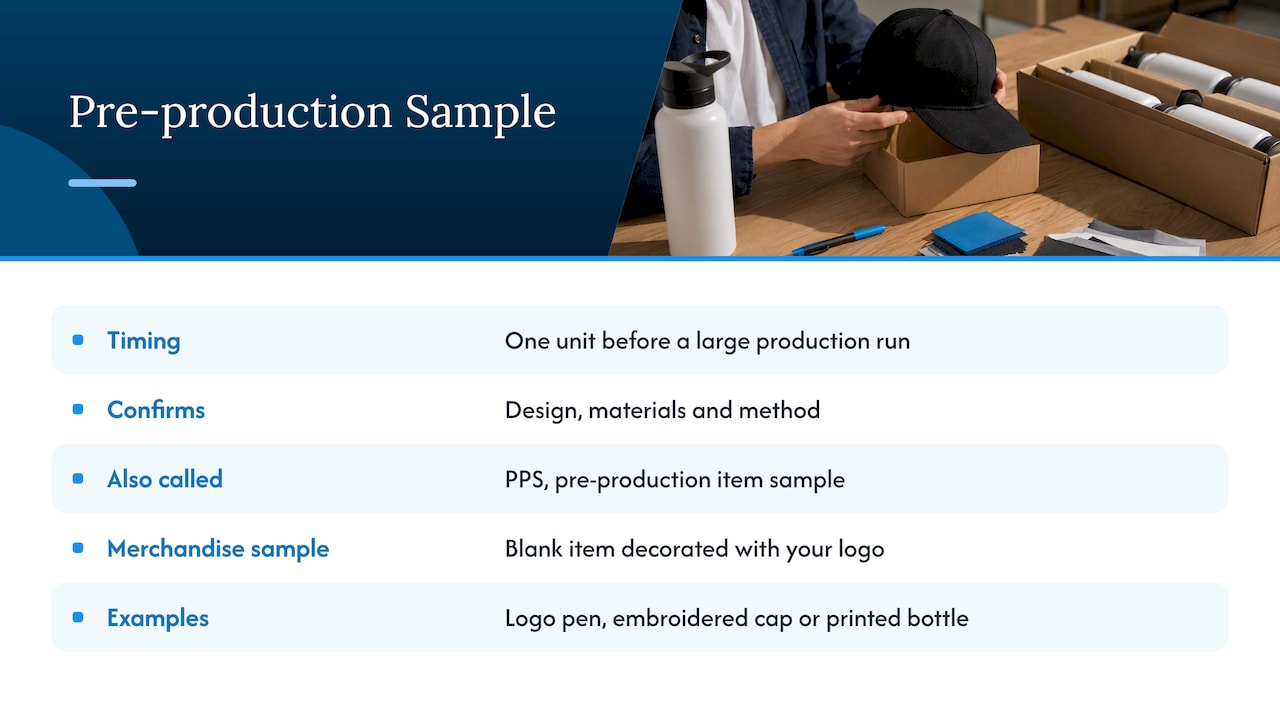
The term comes from manufacturing. Before a factory starts a large run, it makes one unit to confirm the design, materials and method all work together. You may also hear it called a PPS, a pre-production item sample or, in clothing, a trial run sample.
The word “pre-production” also exists in film and project work, where it describes the planning phase before filming. Screen Australia’s development material shows how much planning happens there. The idea is the same in merchandise: find flaws while they are cheap to fix.
For promotional products, a pre-production sample usually means a blank item decorated with your logo. Think of a pen with your logo pad printed, a cap with your embroidery, or a drink bottle with your print in the agreed position.
Pre-production sample vs other samples
Not every sample answers the same question. This table shows the difference.
| Sample type | What it shows | Has your logo? | Best used for |
|---|---|---|---|
| Stock sample | The quality and feel of a standard product | No | Choosing a product |
| Digital proof or mock-up | How your artwork will sit on the item | On screen only | Checking layout and colours on paper |
| Pre-production sample | Your exact order, made the production way | Yes | Final approval before bulk |
| Production sample or random check | Items taken from the finished run | Yes | Checking the batch matches the approval |
Most orders do not need every step. A simple pen order with a clear proof may need only a digital proof. A large apparel run, a new product or a high-stakes launch may justify a physical sample.
When a pre-production sample is worth it
A sample costs money and time. Ask for one when a mistake would be expensive or public.
- Large quantities. A small error across thousands of units is hard to recover from.
- Exact brand colours. Printed colours shift between materials. A sample shows the real result.
- New or custom products. If you have not held the item before, check it first.
- Several approvers. Boards, clients and managers often want to see and touch the item.
- Event deadlines. If the goods must arrive for one date, a late fix is not an option.
- Regulated goods. Food, children’s items and textiles carry labelling rules. More on this below.
For a small, repeat order of a product you already know, a digital proof is often enough. You can skip the physical step and save days.
The approval process, step by step
The sample approval process is simple when you keep it orderly.
- Confirm the product and quantity. Agree the exact item, colour, size and decoration method.
- Supply final artwork. Use vector files where possible. If you do not have artwork ready, our free artwork service can prepare it.
- Approve a digital proof. Check spelling, logo position and Pantone or colour references first. This catches most errors before anything is made.
- Request the pre-production sample. Say clearly that you want it made with production materials and methods, not a lookalike.
- Inspect it against a checklist. Use the list in the next section. Photograph it from several angles.
- Send written feedback. List each change as a numbered point. Vague comments cause rework.
- Approve in writing, or request a revised sample. Approval should name the sample and the date. Keep a copy.
- Keep the sample. Use it as the reference when the bulk order arrives.
The written approval matters. It is the record of what you agreed, and it is the standard the final order is compared with.
What to check on your sample
Work through the item in the same order every time. Hold it, look at it, then compare it to your artwork.
Artwork and branding
- Is the logo the right version, with correct spelling and no stray marks?
- Are the colours close to your brand colours? Check in daylight, not only under office lights.
- Is the logo the right size and in the right place? Our logo placement guidelines explain common positions and how they work on different products.
- Is the logo readable at the distance people will see it? If your merchandise will appear in event photos, it helps to know how to keep logos readable at a distance.
Product quality
- Does the material feel as expected? Compare it with the stock sample you chose from.
- Are stitching, seams, joins and finishes clean?
- Does it work? Test zips, lids, clips, pens and refills.
- Is the size correct? Measure it. Do not rely on a glance.
- Are the print or embroidery edges sharp, with no smudging, fraying or peeling?
Packaging and labels
- Is the packaging the one you ordered? Check the count per carton and any individual wraps.
- Are the labels, swing tags and barcodes correct?
- Is any required wording present, such as care instructions, country of origin or ingredients?
Safety and compliance
This is the part many buyers miss. The sample may look perfect and still lack legal wording. The next section covers what applies.
What Australian rules mean for your sign-off
Approving a sample does not move legal responsibility to anyone else. If you supply goods in Australia, you carry obligations, and the sample stage is the cheapest time to meet them.
According to business.gov.au, mandatory safety standards can cover a product’s performance, composition, design, construction, finish and packaging. Check whether your product category has a standard before you approve.
The ACCC has acted on non-compliance. For example, Davie Clothing gave an undertaking after supplying a children’s wearable hooded towel. Children’s products are a clear case for caution.
The ACCC also warns that businesses are on notice about mandatory standards. Products with button batteries need secure compartments, child-resistant packaging and warnings. If your promotional item has a button battery, such as a light or a small gadget, check these on the sample.
Textiles and clothing
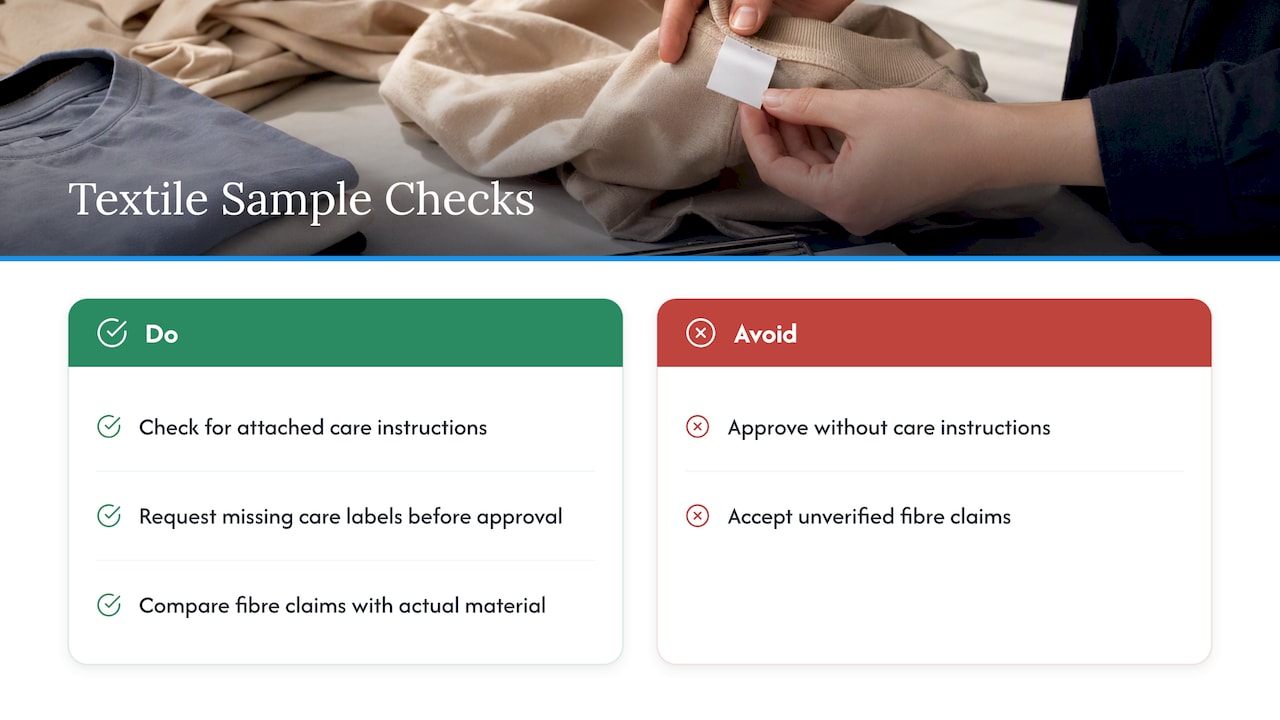
Clothing and textiles need care labelling. The ACCC’s consultation paper notes that the information standard needs adequate care instructions that are permanently attached to clothing. Look for the label on your sample. If it is missing, ask for it before approval.
Fibre content claims must also be correct. The ACCC accepted undertakings from a sock importer that had labelled some socks incorrectly for fibre content. Compare the label on your sample with the actual material.
Branded confectionery
For food, the label is as important as the taste. Allergens must be declared. FSANZ recall notices show how often this goes wrong, such as a recall for undeclared sesame and tree nut in a packaged cookie product. When you review a confectionery sample, read the full ingredient and allergen panel. Also check how your custom wrapper or tin changes the label. Our guide to confectionery packaging in bags and tins covers the options.
Imported goods
Most promotional products are made overseas. Business.gov.au says you can import most goods valued up to A$1,000 without a formal import declaration, and the rules get more complex for higher values. Either way, goods that do not match their labels or descriptions can cause delays. Use the sample to confirm origin labels and fibre content before the order ships.
Do not treat the sample as the last word
Factories can vary between a sample and a full run. Check the delivered batch against your approved sample. Open a carton, test several items and report problems quickly. The sample is your reference, not a guarantee.
Perspective: how we approach sampling
We have supplied branded merchandise in Australia for over 25 years. The pattern is consistent. Most problems come from unclear instructions, not from bad factories.
A few things we have learned:
- Artwork is the biggest cause of rework. Low-resolution logos and unclear colours lead to disappointment. That is why we offer free artwork design, so the file is right before anything is made.
- Factory-direct sourcing helps. We work with a global supply chain and source direct from factories. Fewer hands between you and the maker means fewer places for an instruction to get lost.
- Cheap samples can warn you. Business.gov.au advises that choosing a supplier on the lowest price alone is a risk. We agree. If a sample looks poor, a bulk order rarely improves on it.
- Timing needs honesty. If you have an event date, tell us at the start. Then we can say whether a physical sample fits, or whether a digital proof is the safer route.
Our advice is to match the check to the risk. A big, visible or regulated order deserves a physical sample. A simple repeat order may not.
— PromoShop
Common mistakes at the approval stage
- Approving by email without looking closely. Open the file or hold the item. Do not approve from a thumbnail.
- Judging colour on a screen. Screens differ. Use a physical reference or a colour code.
- Sending feedback in pieces. Collect all notes from every approver, then send one list.
- Forgetting the label. Care labels, allergens and origin marks are part of the product.
- Approving a different product. Make sure the sample uses the same material and method as the bulk order.
- Losing the record. Save your written approval and photos.
Order with a clear sample plan
If you are planning a branded order, start with the product and the deadline. Browse our promotional products range, or look at a category such as drinkware, bags or promotional confectionery. Our custom branding page explains the decoration options. Then get in touch with the details of your order, and we will guide you through the proof and approval steps. We also offer a Price Beat Guarantee on all products, so you can compare quotes with confidence.
FAQ
What is a pre-production sample?
It is one finished item made with the real materials, your artwork and the production method. You approve it before the full order is made. It shows what the bulk order will look like.
Is a pre-production sample the same as a prototype?
No. A prototype tests a new design idea. A pre-production sample confirms an agreed design, with your branding, before bulk manufacturing. It comes later in the process.
Do I always need a pre-production sample?
No. For a simple repeat order, a digital proof is often enough. Choose a physical sample for large quantities, exact colour needs, new products, regulated goods or fixed event dates.
What happens if I find a problem on the sample?
Send a numbered list of changes in writing. The supplier then makes a revised sample or confirms the fix. Do not approve until each point is resolved, because approval is the standard for the bulk order.
Does approval protect me legally?
No. In Australia, businesses that supply goods stay responsible for compliance. A passed sample does not replace checking the delivered batch against the mandatory standards. If you are unsure which rules apply to your product, check business.gov.au or contact the ACCC.
Sources
- Product safety rules and standards, business.gov.au
- Suppliers, business.gov.au
- Importing and your business, business.gov.au
- Businesses on notice as mandatory button battery laws commence, ACCC
- Davie Clothing Pty Ltd undertaking, ACCC
- Care labelling consultation paper, ACCC
- Sock importer undertakings, ACCC
- LOTTE PEPERO recall notice, FSANZ