

October 16, 2026
UV printing is a digital inkjet process that uses ultraviolet light to cure specially formulated inks the moment they land on a surface. That instant cure lets you print directly onto many materials, with durable, vibrant results and products you can handle straight away. Below, we cover how it works, what it suits, and what to plan for.
TL;DR:
- Test each actual substrate before a bulk run because ink chemistry, lamp intensity, and surface energy determine adhesion and complete curing.
- Choose a flatbed for rigid promotional items, or a hybrid when you also print roll media and can accept limits in thickness and rigid output quality.
- Flatbed printers require more upfront investment than hybrid or roll to roll options, while white ink and varnish channels need regular cleaning to prevent clogged nozzles.
- Use UV for short runs, personalized merchandise, and tactile finishes, but request a sample or proof before placing a bulk order.
Table of Contents
- How does UV printing work, from ink to cured surface?
- Which materials can you print on with UV?
- What are the key advantages of UV printing?
- What are the limitations of UV printing?
- Flatbed or hybrid: which UV printer suits your work?
- Which promotional products suit UV printing?
- Our view on when UV is the right call
- How can we help with your UV-printed promotional goods?
- FAQ
- Sources
How does UV printing work, from ink to cured surface?
UV inks are not dried by air or heat. They are made of liquid resins that harden when exposed to ultraviolet light, and a photoinitiator in the ink triggers that reaction. Photochemistry underpins light-driven printing, and the photoinitiator and wavelength together determine how the ink cures.
The process involves the printhead jetting ink onto the surface, followed by a UV lamp curing it into a solid layer. UV’s instant curing means a job can move to finishing immediately.
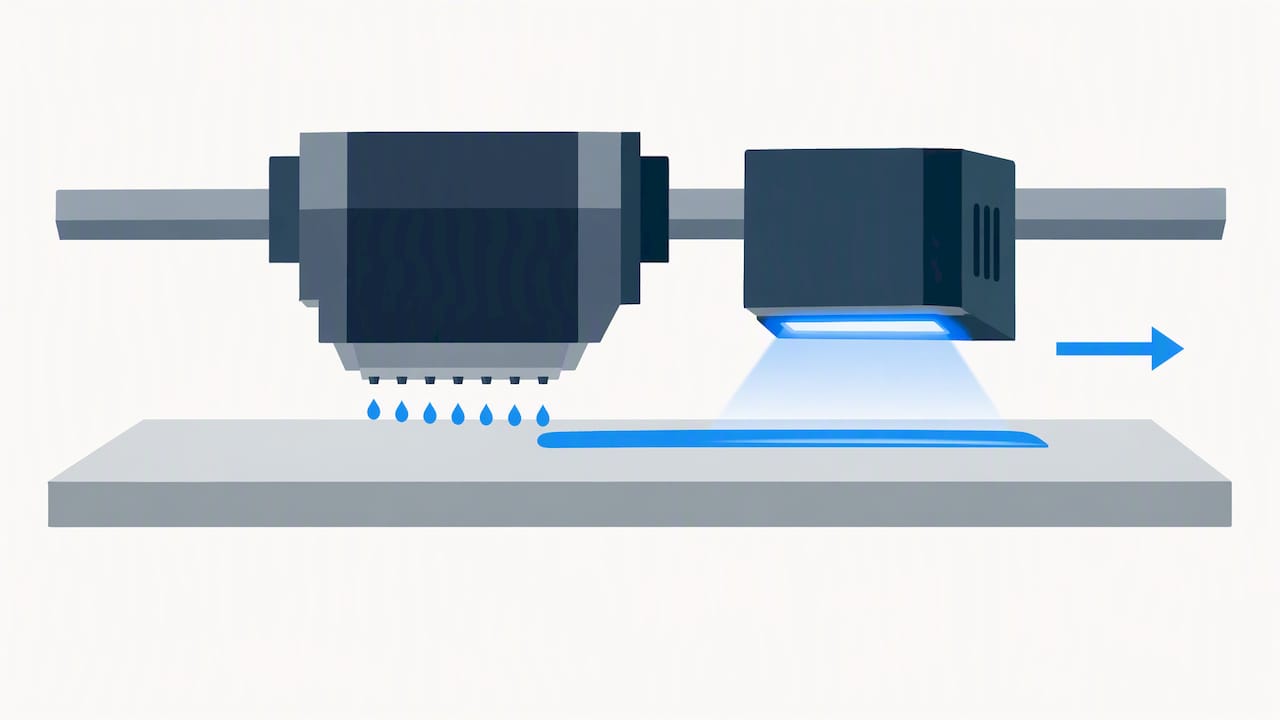
The match matters. Ink chemistry, lamp intensity and substrate surface energy all need to line up, and mismatched ink and lamp types can leave the ink only partly cured.
Signs of an incomplete cure are easy to spot:
- The print feels tacky or sticky to the touch.
- The ink scratches off with a fingernail.
- Colour lifts or smudges when you wipe the surface.
Pro Tip: Always print a test swatch on your actual product before approving a bulk run.
Which materials can you print on with UV?
UV suits a wide range of surfaces. On the rigid side, you can print acrylic, timber, metal, glass and composite panels. Flatbed machines handle these well because the item lies flat under the printhead.
Flexible materials such as PVC and vinyl also work. For curved or irregular objects, check which printing method is suitable for the item. Success with UV depends on understanding surface energy and curing needs, and pre-production testing on your specific material is essential.
Some surfaces need extra care. Preparation helps the ink grip, and not every ink works on every material. Porous materials absorb ink differently, so results can vary.
For promotional goods, this means:
- Bottles and tumblers can carry a direct, durable print.
- Bag tags and tins suit flat or gently curved printing.
- Flags and flexible items may use film or transfer methods.
What are the key advantages of UV printing?
The biggest draw is durability. UV ink resists water, moisture, humidity and abrasion, and it often removes the need for a protective lamination layer.
Appearance is the second draw. UV printers can lay down white ink under colours, add spot varnish for gloss, and build up tactile, raised effects. That gives you a wide colour range even on dark or clear items.
Workflow is the third. Because the ink cures instantly, there is no drying time and no waiting before the next step.
- Prints resist water, moisture, humidity and abrasion.
- White ink and varnish create premium finishes.
- Short runs and personalised items are practical.
Industry experts say the biggest advantage of UV printing is workflow efficiency from instant curing, which opens new revenue opportunities in short runs, personalisation and direct-to-object work.
What are the limitations of UV printing?
UV printing is a strong method, but it asks for planning. Here is what to consider:
- Equipment cost and space. Flatbed UV printers carry a significant footprint and a higher initial cost than hybrid or roll-to-roll options.
- Matching the materials. Ink, lamp and substrate must suit each other, or adhesion and scratch resistance suffer.
- Maintenance. White ink and varnish channels need regular cleaning to prevent nozzle clogging.
- Handling and safety. UV inks need careful storage and operator exposure controls. Australian regulators note that UV ink chemistry in printing often requires handling and exposure controls.
- Training. Nationally recognised units, such as ICPPR452C for specialised printed product, cover setup and drying system monitoring.
Pro Tip: Follow your ink maker’s storage and handling guidance, and train operators before the first job.
Flatbed or hybrid: which UV printer suits your work?
A flatbed printer holds the item on a flat table and suits high-volume rigid-substrate work. A hybrid system can switch between rigid boards and roll-to-roll media, which suits mixed workflows, though with trade-offs in maximum thickness and rigid-output quality.
Weigh these factors before you choose:
- The main substrates you print on.
- Typical run lengths.
- Floor space available.
- Budget, now and for future product lines.
- Whether you will add roll work later.
Our practical view: choose a flatbed for rigid promotional items printed directly, and a hybrid when your work mixes boards and rolls. If colour accuracy matters to you, this guide to ICC colour profiles is a useful next read.
Which promotional products suit UV printing?
UV works well on items that get handled often and need a lasting logo. Drinkware is a suitable option: a Tritan Bottle, Quencher Bottle or Compton Bottle can carry a print.
- Resort Bag Tags and Corporate Bag Tags suit durable direct branding.
- The Tin of Tees suits a high-finish look with spot varnish.
- Car Flags suit film or transfer workflows.
- The Aqua Dry Bag is a product option for branded items.
Ask for a sample or proof before any bulk order.
Our view on when UV is the right call
We help clients choose a print method for each product, and we back that with free artwork design, testing and our express service. We recommend UV for short runs of durable merchandise, direct-to-object jobs and designs that use texture or varnish. Order a sample first, and we will check the quality with you before your full run.
— PromoShop
How can we help with your UV-printed promotional goods?
Printing on bottles, tags and tins should not feel complicated. Our team handles custom branding, and our free artwork design and express service keep your project moving.
Our catalogue includes Resort Bag Tags, Tritan Bottle, Corporate Bag Tags, Quencher Bottle, Aqua Dry Bag 10 L, Compton 700mL Bottle, Tin of Tees and Car Flags. You can also compare decoration methods on our printing options page.
Ready to start? Browse our drinkware range, then request a quote from our sales team at Promoshop.
FAQ
What is UV printing and how does it work?
UV printing is a digital method that cures ink instantly with ultraviolet light as it lands on a surface. The printhead jets the ink, then a UV lamp hardens it into a solid layer. This lets you handle the item straight away.
How expensive is UV ink?
We do not have a published price for UV ink, and cost varies by supplier and printer. The larger cost is usually equipment and training, since higher initial investment is a known trade-off. Ask us for a quote on your specific product.
Is UV DTF better than DTF?
It depends on the item and the print requirements. Check which method is suitable for the product you want to decorate.
Is UV printing raised?
It can be. UV printers can build up varnish and layered ink to create tactile, raised effects. Spot varnish can add texture.
Sources
- [Everything You Need to Know About UV Printing – OMTech AU](https://www.omtech.au/blogs/news/uv-printing)
- UV to open new revenue streams for PSPs - Print21
- Flatbed vs Hybrid UV Printers – Which is Right for Your Australian Print Business? — Kissel+Wolf Australia