


October 27, 2026
For most Australian businesses, stainless steel is the better branded bottle. It survives bags, cars and job sites. Many double-wall vacuum designs also keep drinks cold or hot for hours. Glass wins on pure taste and looks premium on a desk or at a table. It suits a calmer setting, such as a boardroom, a venue or a hotel room.
This guide compares the two on the points that matter when you buy in bulk. These are durability, insulation, weight, safety, recycling, logo printing and care. It also covers what to check on a branded thermos bottle.
TL;DR
- Choose stainless steel for giveaways that will travel: events, field teams, trade shows, staff packs.
- Choose glass for desk, table or in-room use, where taste and a clean look matter more than toughness.
- Insulation is the biggest practical gap. Glass is usually not insulated. Double-wall vacuum stainless steel often is.
- Glass is easy to recycle and stainless steel lasts a long time. Both can be a sound choice if people keep and reuse the bottle.
- Printing differs. Check how the logo is applied and whether it will survive washing before you approve a proof.
Table of Contents
- The short comparison
- Taste and drinking experience
- Durability and weight
- Insulation and hot or cold drinks
- Safety and Australian rules
- Environmental impact
- Printing your logo
- Choosing for your occasion
- What to check on a branded thermos bottle
- Our view: what we would pick, and why
- Order branded bottles with PromoShop
- FAQ
- Sources
The short comparison
Here is the whole decision on one page. The sections below explain each row.
| Factor | Glass | Stainless steel |
|---|---|---|
| Taste | Very neutral | Neutral in good bottles, a metallic note is possible in poor ones |
| Drop resistance | Can chip or break | Can dent, rarely breaks |
| Weight | Heavier for the capacity | Lighter, even when double-walled |
| Insulation | Usually none | Often double-wall vacuum |
| Hot drinks | Only if made for it | Suitable if the bottle is designed for hot drinks |
| Printing | Screen print, ceramic or UV inks | Screen print, pad print, laser engraving |
| Best for | Desks, venues, gifts that stay put | Events, travel, work sites, daily carry |
Taste and drinking experience
Glass does not add a flavour to water. That is its main selling point. If you hand out bottles for water, herbal tea or cold-pressed juice, glass keeps the drink tasting like itself. Some people also like the way it looks. They can see what is inside and see that the bottle is clean.
Stainless steel bottles are neutral too, if the steel and the lid are good quality. A cheap lid seal or a poorly finished interior can leave a taste. This is a quality question, not a material question. Ask for a sample before you commit to a large run. Fill it, leave it overnight and taste it.
Taste matters to your recipients more than you might expect. A bottle that tastes odd goes to the back of the cupboard. A bottle with your logo in the back of a cupboard does nothing for your brand.
Durability and weight
This is where the two materials split most clearly.
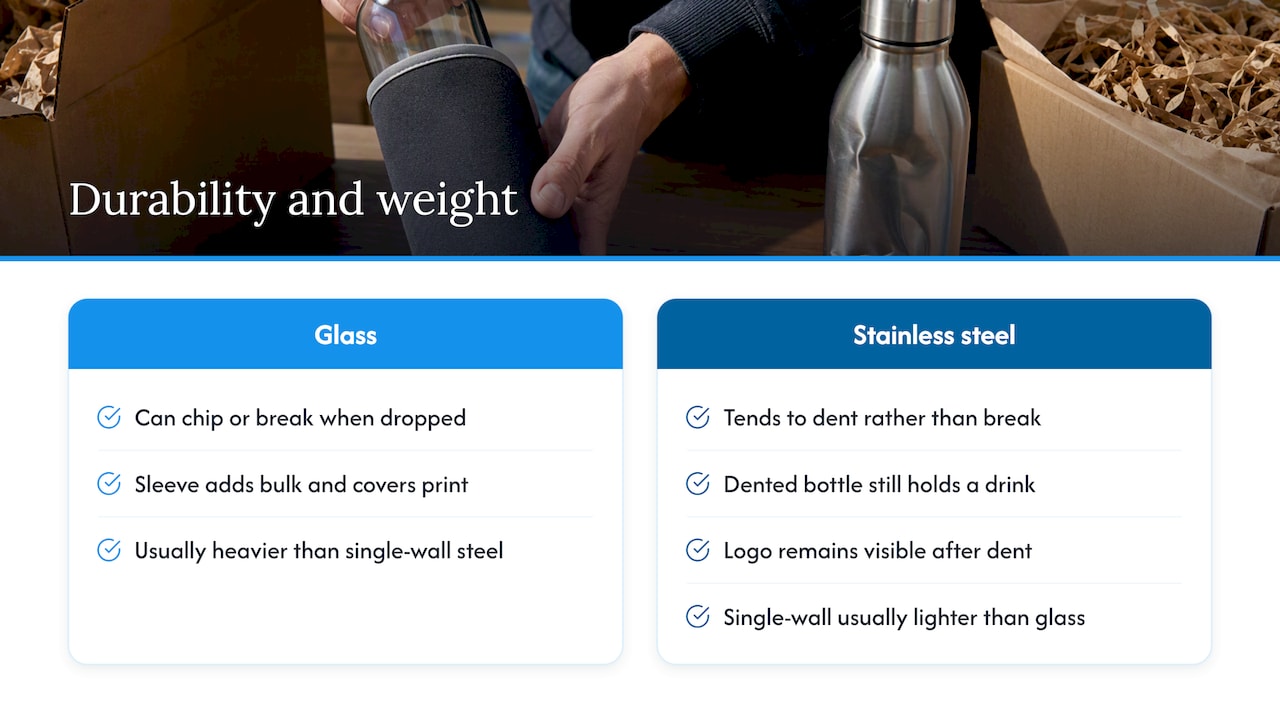
Glass can chip or break if it is dropped on a hard floor. Safety guidance from Food Standards Australia New Zealand notes that chipped glass can create a glass-shard hazard in food settings. Most reusable glass bottles come with a silicone sleeve to soften knocks. A sleeve helps, but it adds bulk and covers part of the print area.
Stainless steel tends to dent rather than break. A dented bottle still holds a drink. It still shows your logo. That matters when you hand out hundreds of bottles, because some will be dropped, kicked around a ute or thrown into a gym bag.
Weight follows the same pattern. A glass bottle is usually heavier than a single-wall steel bottle of the same size. A double-wall steel bottle can close the gap, though it is not always lighter. If people will carry the bottle all day, compare actual weights on the product page before you order.
For a conference bag already full of brochures and a laptop, a lighter bottle is more likely to be kept and used.
Insulation and hot or cold drinks
Most glass bottles have no insulation. Your drink warms up or cools down with the room. That is fine for a meeting-room bottle that gets refilled all day.
Many stainless steel bottles use double-wall vacuum construction. A vacuum layer between the walls slows heat transfer. Makers often rate these bottles at around 24 hours cold and 12 hours hot. Treat those figures as a best case under test conditions. Real results depend on the bottle size, the starting temperature, how often the lid is opened and how full the bottle is. Ask your supplier what the rating is based on.
For hot drinks, check that the bottle is made for them. Not every bottle is. Some lids are not designed to hold pressure from hot liquid. Check the product description and the care notes.
On our site you can browse vacuum stainless steel bottles and a double wall vacuum stainless steel bottle to see how the specifications are listed.
Safety and Australian rules
Neither material is a problem when it is made for food contact and used as intended. The rules are general, though, so quality still matters.
Food Standards Australia New Zealand explains that Standard 1.4.3 covers food-contact materials in general terms. It does not set out rules for each packaging material. The practical guidance is more specific. Food-contact surfaces need to be easy to clean and made from material that will not contaminate food. The same FSANZ guide to the food safety standards says suitable grades of stainless steel are generally likely to be suitable.
FSANZ also points out that contamination can come from chemicals or from foreign objects such as glass. It adds that contamination may not change the taste, smell or look of a product. In plain terms, you cannot judge safety by tasting the bottle.
What to do with this:
- Ask your supplier to confirm the bottle is intended for food and drink contact.
- Ask which stainless steel grade is used for the inside of the bottle.
- Check lids, seals and straws as well. They are often the weak point, not the body.
- For glass, ask about the glass type. Toughened or borosilicate glass copes better with knocks and temperature changes than ordinary glass.
- If you give bottles to people in care, health or school settings, tell your supplier. Some buyers in those settings prefer to avoid glass altogether.
If you have a specific compliance question, such as bottles for a food business or a government tender, speak to your own compliance adviser or the relevant state or territory food authority.
Environmental impact
There is no simple winner. Each material has a good story and a limit.
Glass is widely recycled in Australia. The Australian Packaging Covenant’s material flow analysis reports a 68% collection rate for recycling of glass packaging in 2020–21. An analysis for NSW found net benefits from recycling glass containers, including lower greenhouse gas emissions and lower energy demand. The limit is weight. An Australian and New Zealand life cycle assessment found that glass packaging had a considerably higher carbon footprint than cartons because of its high mass. Heavier products cost more to move.
Stainless steel is a metal, and metal packaging also has strong recovery. The same Covenant analysis reports an 85% recovery rate for container deposit scheme eligible metal packaging. Be careful with that figure. It covers packaging such as cans, not reusable bottles. We cite it only to show that metal recovery systems work in Australia.
The bigger point is how long the bottle is used. A reusable bottle only helps if people keep using it. A bottle that is used for years beats a bottle that is used twice and thrown out. That favours the tougher, more useful product, which for most recipients is stainless steel. For a recipient who will use it on a desk, glass can last just as long.
Printing your logo
The two materials take branding differently. This is the point that most buyers search for, so it is worth getting right.
Printing on glass
Glass is smooth and non-porous. Ink needs to bond well. Research on UV inks for glass containers shows that durability depends on the glass type, pretreatment, UV dose, ink thickness and ink chemistry. UV and LED curing is an effective option. In practice this means two things for you:
- Print quality varies between suppliers. Ask what ink system is used and whether the print is rated for washing.
- Simple one or two colour logos on a flat area print most cleanly. Fine detail and gradients are harder.
Also ask how the print will sit around a silicone sleeve or a curved shoulder. Put the logo where it stays visible.
Printing on stainless steel
Steel bottles are commonly branded with screen printing, pad printing or laser engraving. Engraving removes the finish, so the logo is part of the bottle and cannot wear off. Printed logos give you colour. Powder-coated bottles let you match a brand colour for the body as well.
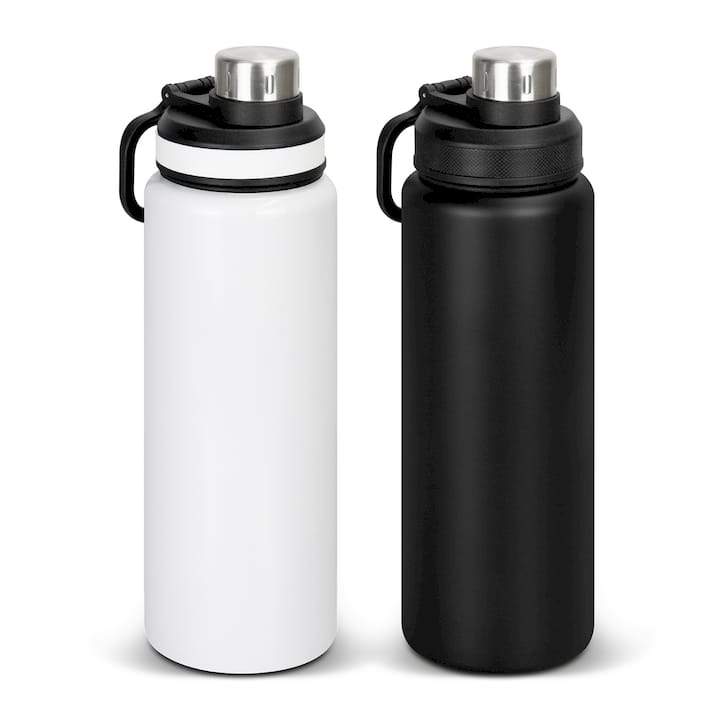
Each method suits different artwork. This is where free artwork support helps. We prepare your logo for the chosen method and send a proof before production, so you can see placement, size and colour first.
Care instructions
Whichever you choose, tell recipients how to wash the bottle. Hand washing keeps a printed logo looking good for longer than the dishwasher does. Add a small care card or a line on the packaging. It costs very little and protects the look of your brand.
Choosing for your occasion
Trade shows and conferences. Pick stainless steel. Bottles get packed, dropped and carried through airports. A lighter, tough bottle is more likely to make it home and get used.
Staff onboarding and uniforms. Stainless steel again, ideally double-wall. Teams on site, in vehicles or outdoors benefit from drinks that stay cold.
Client gifts. Both work. A glass bottle in a gift box looks refined. A premium vacuum bottle feels useful. If your client travels, choose steel. If they work mostly at a desk, glass is a good call.
Hospitality, venues and wellness brands. Glass fits the setting. It reads clean and simple, and it suits water, infusions and juice.
Fundraisers, schools and community events. Lighter or unbreakable options are usually safer. Consider steel or a durable plastic option such as a Tritan bottle.
Coffee and tea drinkers. A bottle may not be the answer. A reusable coffee cup can suit commuters better.
What to check on a branded thermos bottle
People who search for branded thermos bottles want an insulated stainless steel bottle with a logo. Use this checklist before you order.
- Insulation type. Look for double-wall vacuum construction. Ask what the hot and cold ratings are based on.
- Capacity. Common drink bottle sizes suit different uses. A smaller bottle fits a bag and a car cup holder. A larger bottle suits site work. Check that it fits a standard cup holder if that matters to your audience.
- Lid. Is it leak-proof, or only splash-resistant? Can it be used with hot drinks? Does it have a carry loop? Test it upside down in a bag with a sample.
- Mouth opening. A wide mouth is easier to fill with ice and to clean. A narrow mouth is better for sipping.
- Finish. Powder-coated finishes grip well and take colour. Brushed steel looks classic. Check that the print area suits your logo size.
- Care. Check whether it is dishwasher safe. Many vacuum bottles are best hand washed.
- Colour and quantity. Confirm minimum order quantities and colour options before you promise a launch date.
You can compare these points across our stainless steel drink bottles, another stainless steel option and a third style. The full range sits in our promotional drink bottles category.
Our view: what we would pick, and why
We have supplied branded merchandise in Australia for over 25 years. Drinkware is one of the products businesses ask about most. Here is how we advise customers.
We start with the person who will hold the bottle. Where will they use it? Will it travel? Will it be washed by hand? Those answers decide the material faster than any spec sheet.
For most campaigns, we point customers to stainless steel. It handles real life. It suits hot and cold drinks. A logo on a bottle that people use every day gets seen again and again.
We recommend glass for a narrower set of uses: desk gifts, venue and hospitality settings, and wellness brands. In those settings, taste and looks matter most, and the bottle is not likely to be dropped.
We also look at the factory side. We source factory-direct through a global supply chain, so we can compare quality across materials at a competitive price. We ask for samples when a customer is unsure. We also prepare your artwork for free and send a proof, so you see your logo before anything is made.
— PromoShop
Order branded bottles with PromoShop
If you know your audience and your budget, the next step is simple. Browse our promotional drinkware range, choose a bottle and send us your logo. We offer free artwork, an express service for tight deadlines and a Price Beat Guarantee. Visit PromoShop to request a quote, or get in touch with our team if you want help choosing between glass and steel.
FAQ
Which is healthier, stainless steel or glass?
Both are suitable for drinks when made for food contact. Glass is very neutral and does not add flavour. Good stainless steel is also considered suitable for food contact in FSANZ guidance. The bigger risks are poor quality lids and seals, and chipped glass. Ask your supplier to confirm the bottle is intended for food and drink.
Is stainless steel insulated?
Not always. Single-wall steel bottles are not insulated. Double-wall vacuum bottles are. Check the product description for the words double wall or vacuum. Ask what the hot and cold times are based on.
Can you print a logo on a glass bottle?
Yes. Glass can be screen printed or printed with UV inks. Durability depends on the glass, the ink and how the print is cured. Ask your supplier whether the print is suited to washing, and give recipients hand-wash care advice.
Are glass bottles a good choice for giveaways?
They can be, in the right setting. Glass suits desks, venues and gift boxes. For crowded events, travel or outdoor work, stainless steel is safer and lighter. Think about where the bottle will end up.
Which bottle is more environmentally friendly?
Neither wins in every case. Glass is widely recycled in Australia but is heavy to make and move. Stainless steel is tough and lasts a long time. The best choice is the bottle your recipients will keep using.
Sources
- FSANZ guide to the food safety standards, Chapter 3.2.3
- FSANZ Standard 3.1.1 interpretation and application
- FSANZ activities in relation to bisphenol A
- NSW EPA: environmental benefits of recycling, glass
- Australian Packaging Covenant: Packaging Material Flow Analysis 2020-21
- LCA of beverage and food packaging in Australia and New Zealand
- Achieving durability on glass containers with UV screen inks