
October 23, 2026
Most custom embroidery orders take between one and three weeks from the day your artwork is approved. Simple orders can be faster. Large orders, caps, tricky logos and busy seasons can take longer. The clock rarely starts when you place the order. It starts when artwork, quantities, sizes and payment are all confirmed.
This guide shows what makes up that time, what slows it down, and how to plan so your branded polos, caps or jackets arrive before your event.
TL;DR
- Plan on roughly 1 to 3 weeks from artwork approval for standard embroidery. Always confirm the exact date in writing when you accept a quote.
- The biggest delays happen before production: unclear artwork, late approvals and missing size splits.
- Caps, thick garments, many logo positions and high stitch counts add time.
- Rush options exist, but they work best when your artwork is final and your garments are simple.
- Build in a buffer for freight and for peak periods such as end of financial year and pre-Christmas.
Table of Contents
- How long does embroidery take, from order to delivery?
- What happens during each stage
- What makes embroidery take longer
- Typical timelines by order type
- How to speed up your order
- Rush embroidery: what is realistic
- Embroidery or printing: does it change the timeline?
- Questions to ask before you accept a quote
- Planning for different buyers
- Our view: plan the approval, not just the production
- Get your embroidery quote from PromoShop
- FAQ
- Sources
How long does embroidery take, from order to delivery?
There is no single national figure. Providers publish very different lead times. Some quote a few business days. Others quote two to four weeks. The difference comes from what each one counts and how they work.
Some studios count from payment. Others count from artwork approval. Some count only production, not freight. When you compare quotes, compare the same starting point and the same finish line.
A practical way to think about it is as four stages:
- Quote and artwork: you send your logo and your quantities. The supplier prepares a quote and a proof.
- Approval: you confirm the proof, sizes and colours. You pay or approve the quote.
- Production: the design is digitised, garments are sourced or received, and the embroidery is stitched.
- Finishing and delivery: items are trimmed, checked, packed and sent.
Stages one and two are where most orders lose days. Production itself is often the shortest part of the timeline.
What happens during each stage
Quote and artwork
An embroiderer cannot stitch a logo exactly as it appears on screen. The design has to be converted into a stitch file. This is called digitising. It tells the machine where each stitch goes, in what direction, and in what order.
A clean vector file speeds this up. A small, blurry image slows it down because someone has to rebuild it. If your logo is not ready, we offer free artwork help so you are not stuck at this step. If you are still working on the logo itself, a guide on professional logo creation without delays can help you get a usable file sooner.
Approval
This is the step you control. A proof is only useful if you answer it. Orders often sit for days because the person who approves the proof is away, or because someone else wants to change the thread colour.
Before you request a proof, agree internally on three things: the logo placement, the thread colours and the final sizes. A single round of changes is normal. Three rounds will add days.
Production
Once the design is approved, the supplier sources the garments. If they come from a factory or warehouse, stock availability matters. Then the garments are hooped and stitched. Quality checks follow.
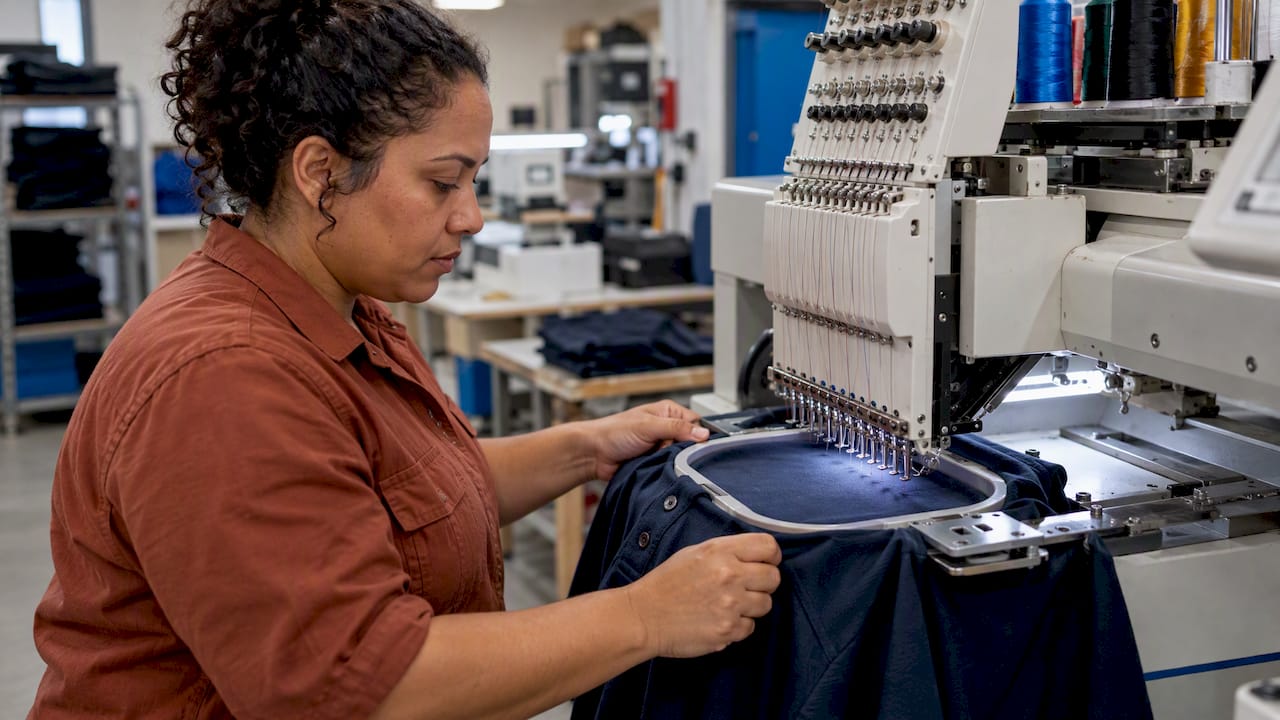
Embroidery quality depends on proper setup. Industry guidance on hiring embroidery services notes that quotes differ because providers make different assumptions about digitising, materials and review rounds. A very cheap and very fast quote may have skipped some of that setup.
Finishing and delivery
After stitching, backing is trimmed and loose threads are removed. Each item is checked and packed. Then freight adds its own time, which depends on where you are. A delivery to metropolitan Perth is quicker than one to a regional town. If you are in Western Australia, our Perth team page shows how we support local businesses.
What makes embroidery take longer
Two orders with the same quantity can have very different lead times. These are the usual reasons.
Order size
A run of 20 polos is quick. A run of 500 needs more machine hours. Embroidery machines stitch one garment at a time per head, so volume translates directly into time. Larger orders may also be split across several machines or batches.
Stitch count and design complexity
Stitch count is the number of stitches in a design. A small left-chest logo might be a few thousand stitches. A large back-of-jacket design can be many times that. More stitches mean more machine time per item, and often a higher price.
Pricing and scheduling often follow the same logic. An Australian sewing industry article explains that stitch count is a common basis for pricing embroidery, and that the cost per 1,000 stitches usually falls as volume rises. Time works in a similar way: setup is a fixed effort, so bigger runs spread it out.
Colour count matters too. Each thread colour change adds a pause. A logo with six colours takes longer than a logo with two.
Number of logo positions
A logo on the left chest is one pass. Add a sleeve and a back, and every garment goes through the machine three times. Each position may need its own digitised file and its own hooping.
Garment type
Polos and t-shirts are straightforward. Caps need special hooping and a different frame. Thick jackets, fleece and bags can be harder to hold in place. These items often take a little longer, and some suppliers set different minimums for them.
Busy periods
Demand is not even across the year. Studios tend to get busy around the end of the financial year, before Christmas, and around sporting finals and conference seasons. In those weeks, a standard lead time can stretch. Ask your supplier whether the quoted date allows for the current workload.
Stock and sourcing
If garments need to be ordered in, the supplier may wait on stock before they can start. A popular colour in a popular size can sell out. If your timeline is tight, ask early whether stock is confirmed.
Typical timelines by order type
These are planning estimates, not promises from any one supplier. Use them to sense-check a quote. Your confirmed quote is the figure that counts.
| Order type | What to plan for | Main risk to the date |
|---|---|---|
| Small run of polos or tees, one logo | Shortest end of the range | Late proof approval |
| Caps and headwear | Allow a little more time than shirts | Stock and hooping setup |
| Jackets, fleece, bags | Allow extra time | Thick fabric, multiple positions |
| Large orders, 100 plus items | Longer, often split into batches | Machine hours, stock |
| Multi-position uniforms | Longer again | Several logo files and passes |
The safest approach is to ask your supplier for a date, not a number of days. A date forces them to check the workload, the stock and the freight.
How to speed up your order
You cannot change machine speed. You can remove delays around it. Here is what helps most.
- Send a vector logo. Files such as AI, EPS or SVG are best. A clear PDF can also work. Avoid screenshots.
- Decide your sizes first. Collect the size split from your team before you ask for a quote.
- Choose thread colours early. Have the brand colours ready. If you have Pantone references, include them.
- Name one approver. One person signs off on the proof. This avoids a chain of replies.
- Keep the design simple. Fewer colours and a smaller stitch count run faster.
- Order stock items. Garments that are already in the supplier’s warehouse avoid sourcing delays.
- Confirm the delivery address. A business address with someone on site avoids missed deliveries.
- Ask about the freight method. Express freight can recover days after production.
If you want a fuller look at fast options across product types, our rush promotional products guide covers what is realistic when your deadline is close.
Rush embroidery: what is realistic
Rush service exists, but it is not magic. A supplier can move your order up the queue. They cannot invent a proof approval that has not happened or a garment that is not in stock.
Rush orders work best when:
- your artwork is final and in a usable file format;
- the garments are in stock;
- the design is simple, with few colours and one position;
- you can approve the proof the same day;
- the quantity is modest.
Rush orders often cost extra, because they interrupt a planned schedule. Ask for the rush cost in writing before you agree. Also ask whether the rush date includes freight or only production.
If your deadline is a firm event date, work backwards. Take the event date. Subtract a buffer of a few days for freight problems. Subtract the production time. Subtract the time you need to approve the proof. That final date is when you must place the order, not when you start thinking about it.
Embroidery or printing: does it change the timeline?
Sometimes. Printing methods do not need the same digitising step, and they can handle many colours without thread changes. Embroidery tends to suit polos, caps and uniforms where a textured, long-lasting finish matters. If time is your main concern, ask which method suits your artwork and garment. Our page on embroidery versus printing for logos compares the two, and our polo shirt branding guide shows the logo options available for polos.
The best choice is the one that looks right for your brand and fits your date. A fast job that looks poor costs more than it saves.
Questions to ask before you accept a quote
Quotes that look similar can hide different timelines. Ask these questions so you compare like with like.
- When does the turnaround clock start: payment, quote approval or artwork approval?
- Does the lead time include delivery?
- Is the stock confirmed, or does it need to be ordered?
- How many proof revisions are included?
- Is digitising included, or charged separately?
- What happens if the order is late?
- Is there a rush option, and what does it cost?
Cockatoo’s guide makes a related point: written briefs that include timing constraints let providers quote the same job rather than guessing. Put your deadline in the brief from the start.
Planning for different buyers
Small businesses
If you are ordering uniforms for a few staff, keep things simple. One logo, one position, stock garments. You will get a short lead time and a fair price. Think about ordering a few extra sizes for new starters so you do not need a second run.
Event planners
Your date is fixed. Order early, and treat the proof approval as the real deadline. Ask for a delivery date at the venue. If the event is a conference, our branding guide can help you choose products and decoration methods that suit your schedule.
Marketing teams
Campaign launches slip often. Lock the creative before you ask for quotes. Branded apparel is a part of wider brand work, and resources on apparel marketing for brands can help you plan how uniforms and merchandise fit a campaign calendar.
Consultants and client gifts
Gifts tend to be small runs with a tight date. Choose items that are in stock and need only one decoration position.
Our view: plan the approval, not just the production
We have been in the promotional products business for over 25 years. In that time one pattern has stayed the same. Customers ask how long production takes. The better question is how long it takes to get to a finished, approved design.
Production is predictable. People are not. A proof waits for a manager to return. A logo file turns out to be too small. A size list changes the day before the order is placed. Each of those adds days, and none of them are the fault of the machine.
This is why we offer free artwork design. A logo that is ready for production removes the first big delay. We also offer an express service for orders with firm dates, and we source through a global supply chain with factory-direct product sourcing, so we can often work with stock rather than wait for it.
Our advice is simple:
- Send your best logo file at the start.
- Tell us your event date in your first message.
- Approve the proof as soon as you can.
- Ask us for a confirmed date, not an estimate.
If you tell us what you need and when you need it, we will tell you what is realistic. If it is not, we will say so early, so you can change the plan and not the date.
— PromoShop
Get your embroidery quote from PromoShop
Need branded polos, caps or uniforms by a set date? Tell us your quantity, your logo and your deadline. We offer custom branding, free artwork and an express service, and our Price Beat Guarantee applies across our products. Start at PromoShop and get in touch with our team. We are here to assist.
FAQ
How long does embroidery take?
For most business orders, plan on one to three weeks from artwork approval. Small, simple orders can be quicker. Large runs, caps and multi-position designs take longer. Ask for a confirmed delivery date when you accept the quote.
When does the turnaround time start?
It depends on the supplier. Some count from payment, some from quote approval, and others from artwork approval. The safest way is to ask. The clock rarely starts until your artwork, sizes and payment are all confirmed.
Can I get embroidery done in a few days?
Sometimes. It works best with stock garments, a final logo file, a simple design and a same-day proof approval. Rush service usually costs more. Check whether the date includes delivery.
Does a bigger logo take longer to embroider?
Yes. A larger logo has a higher stitch count, so each garment takes more machine time. More thread colours and more logo positions also add time. A simplified design can shorten the schedule and reduce the price.
How far ahead should I order for an event?
Work back from the event date. Allow time for proof approval, production, freight and a few spare days. In busy periods such as end of financial year and before Christmas, order earlier than you think you need to.