
October 24, 2026
Choose sublimation when you want full-colour, edge-to-edge artwork on polyester or coated items. Choose screen printing when you want bold, opaque colour on cotton and other natural fabrics, especially in larger runs. That is the short answer. The right choice for your order depends on the product, the fabric, the artwork and the quantity.
This guide walks you through each method in plain terms. You will see how they work, where each one is strong, where each one falls short, and how to decide. If you are still unsure after reading, send us your artwork. We will help you pick.
TL;DR
- Sublimation turns dye into gas and bonds it with polyester or a polymer-coated surface. It gives full-colour, photographic results with no feel on the fabric.
- Screen printing pushes thick ink through a stencil. It gives vivid, opaque colour on cotton, blends, bags, paper and more.
- Sublimation does not work well on cotton or dark fabrics. Screen printing handles both.
- Screen printing costs less per piece as quantities rise. Sublimation has no screen setup, so it suits complex artwork and smaller runs.
- Not sure? Send us your logo and quantity. Our artwork team can help for free.
Table of Contents
- How sublimation works
- How screen printing works
- Sublimation vs screen printing at a glance
- When to use sublimation
- When to use screen printing
- A worked example
- Where DTF fits in
- What about cost?
- Durability and care
- Our view at PromoShop
- Order with PromoShop
- A quick checklist before you order
- Common mistakes to avoid
- FAQ
- Sources
How sublimation works
Sublimation is a digital process. The design is printed onto special transfer paper using sublimation dye. The paper is placed against the product. A heat press then applies heat and pressure. The dye turns to gas and moves into the surface.
The result is not a layer of ink on top. The colour becomes part of the material. Sublimation uses heat to transfer dyes onto polyester fabric, ceramic, metal and plastic, as long as the item is polyester or has a suitable coating.
This is why sublimated prints:
- Have no raised feel. You cannot feel the print with your fingers.
- Do not crack or peel in the way a surface layer can.
- Can cover a whole garment, panel or product from edge to edge.
- Can hold gradients, photos and many colours at no extra cost per colour.
The method is common on sports jerseys, lanyards, flags, banners and coated mugs. Digital sublimation can handle a wide range of textiles. Roland’s sublimation guide notes this includes stretchy sports fabrics as well as heavy canvas.
The limits of sublimation
Sublimation has clear limits. Know them before you order.
- Fabric. Cotton does not take the dye properly. The print will look faded or wash out. You need polyester, or a high polyester content.
- Garment colour. The dye is see-through. It adds colour to the surface rather than covering it. A white or very light base gives the truest result. A dark shirt will swallow the print.
- No white. The process cannot print white ink. White in your design is simply the colour of the base item.
- Product choice. Only items made or coated for sublimation will work. Many standard promotional items are not.
How screen printing works
Screen printing is a stencil method. A mesh screen is prepared for each colour in your design. Ink is pushed through the open areas onto the product. Each colour is applied in turn. Then the ink is cured with heat so it stays put.
The ink sits on the surface. It is thick and opaque. That is why screen printing looks so strong on dark garments and keeps its punch wash after wash.
Screen printing is a good fit for:
- T-shirts, polos and hoodies in cotton or blends
- Tote bags and cotton bags
- Caps and other headwear, depending on the shape
- Paper and card items
- Some hard goods, depending on the shape
If you want to see the full range we offer, our printing options page sets out each method.
The limits of screen printing
- Setup. Every colour needs its own screen. A logo with one or two colours is simple. A photo or a gradient is not.
- Cost on small runs. The setup cost is spread over the order. On very small quantities, the cost per piece rises.
- Colour count. More colours mean more screens. More screens mean a higher price.
- Fine tonal detail. Photographic artwork is not the strength of this method.
Sublimation vs screen printing at a glance
| Factor | Sublimation | Screen printing |
|---|---|---|
| Best fabric | Polyester or polymer-coated items | Cotton, blends, many other materials |
| Dark garments | Poor result | Strong, opaque colour |
| Artwork | Full colour, photos, gradients | Best for logos with a few solid colours |
| Feel | No feel, part of the fabric | Ink sits on the surface |
| Setup | None per colour | One screen per colour |
| Best quantity | Low to medium runs, or complex artwork | Medium to large runs |
| Edge-to-edge print | Yes | Limited |
| White ink | No | Yes |
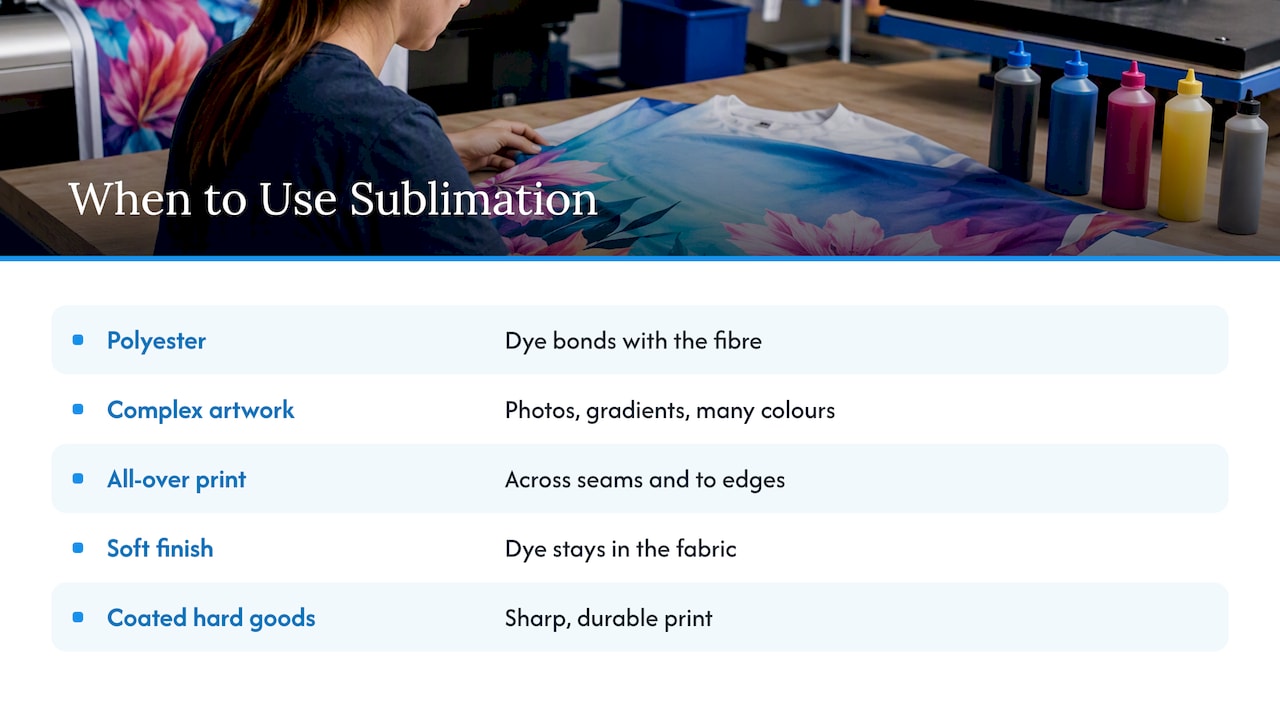
When to use sublimation
Sublimation is the better call in these cases.
1. The product is polyester. Think sports tops, activewear, team uniforms, lanyards, flags and banners. The dye bonds with the fibre, so it suits these items best.
2. The artwork is complex. If your design has photos, gradients or many colours, sublimation prints them all in one pass. Screen printing would need many screens.
3. You want an all-over print. A design that runs across seams and to the edges is a job for sublimation.
4. You want a soft, breathable finish. Because the dye is in the fabric, activewear keeps its stretch and feel.
5. The item is a coated hard good. Some mugs, drink bottles and other items are made with a coating for sublimation. If the item is built for it, the print is sharp and durable.
When to use screen printing
Screen printing is the better call in these cases.
1. The garment is cotton. Cotton tees, polos and fleece are the classic screen print products.
2. The garment is dark. Opaque ink covers the base colour. Your logo stays bright on navy, black or forest green.
3. The logo is simple. One to three solid colours is the ideal range. Corporate logos usually fit.
4. The run is large. Once the screens are made, each extra piece costs little. Larger runs bring the unit price down.
5. You need an exact brand colour. Screen printing can match a specific colour. This matters for brand consistency across a whole team or event.
A worked example
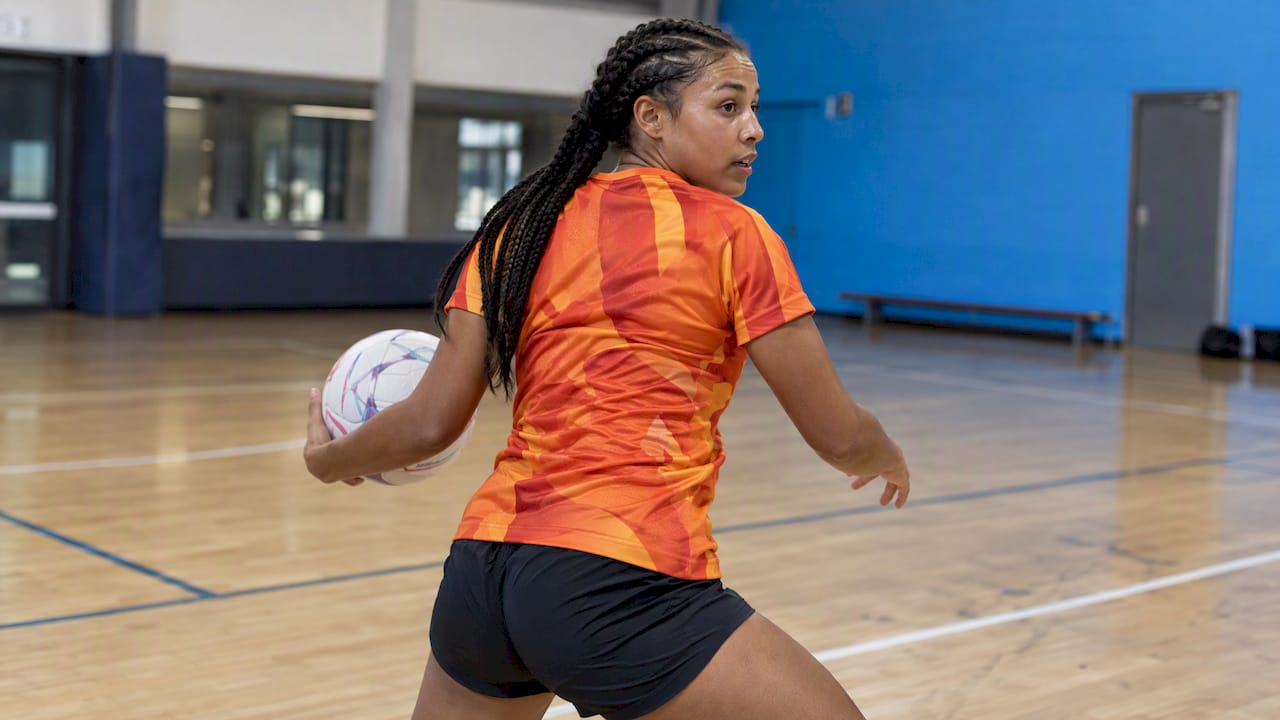
You run a regional netball club. You need 40 playing tops with a full-colour design that runs across the front, back and sleeves. The fabric is polyester. Sublimation is the clear choice. The design reaches the seams. It has gradients. It will stretch and move with the players.
Now take a different job. You are a small trades business. You need 120 black cotton work shirts with a two-colour logo on the chest. Screen printing is the clear choice. The ink covers the dark base. The logo is simple. The quantity is high enough to spread the setup cost.
One more. You run a conference and need 60 tote bags for delegates. The bags are cotton. The logo has one colour. Screen printing again.
The pattern is simple. Match the method to the fabric first. Then check the artwork. Then check the quantity.
Where DTF fits in
Many buyers now ask about a third option. Direct to Film, or DTF, is a digital transfer method. It prints the design onto film. The film is then pressed onto the garment.
It is easy to mix DTF up with screen print transfers. They are not the same. DTF is a modern digital process with no order minimums and full-colour capability. Screen print transfers are screen printing onto release paper, which is later heat pressed. They need screen preparation, so they cost more on small multi-colour jobs.
Some industry commentary says DTF has bridged the gap between the two traditional methods. It offers full-colour, small-batch printing on almost any fabric type. Neither sublimation nor screen printing can claim that on its own.
If your order is small and your fabric is cotton, DTF or heat transfer may be the best fit. Read our guides on DTG vs screen printing and heat transfer vs screen print for the numbers on small runs.
What about cost?
We cannot give one price for every job. Cost depends on the product, the quantity, the number of colours and the print area. Here is how each method behaves.
- Sublimation. There is no screen setup. The cost per piece stays fairly steady as colours increase. Large print areas and special fabrics can raise the price.
- Screen printing. Setup is the main cost. After that, each piece is cheap. Each added colour adds a screen.
So the rule of thumb is this. Few pieces and many colours favour a digital method. Many pieces and few colours favour screen printing.
For an exact figure, ask for a quote. We do not publish prices for custom jobs, because each one is different. Our team will give you a clear number before you commit.
Durability and care
Both methods last well when the job is matched to the product.
- Sublimated prints sit inside the fibre. They resist cracking and peeling. Colour holds well when the garment is washed as directed.
- Screen prints sit on the surface. A well-cured print wears well. Over many washes, a heavy print may show some fade or fine cracking.
Care matters for both. Follow the garment’s wash label. Wash inside out when you can. Avoid high heat and harsh detergents. These steps keep any print looking better for longer.
Our view at PromoShop
We see the same mistake often. A buyer picks the method first, then finds it does not suit the product. We suggest you work in the opposite order.
Start with the product. What is it made of? What colour is it? Who will use it, and how often?
Then look at the artwork. How many colours does it have? Does it include a photo or a gradient?
Then look at the quantity. Is it 30 pieces or 300?
These three answers point to the method. We source our products through a global supply chain with factory-direct sourcing. That gives us a wide choice of items made for each printing method. It also lets us offer competitive pricing.
We also offer free artwork design. Many files arrive in a format that does not suit the method. We prepare them so they print well. You do not need to be a designer. You do not need to know which file type is best.
And if you find a lower price on the same product, our Price Beat Guarantee applies. Get in touch and we will look at it.
— PromoShop
Order with PromoShop
Ready to go? Our team can brand your order with the method that suits it. We cover apparel, bags, drinkware, pens, caps and corporate gifts. We offer free artwork, custom branding and an express service for tight deadlines.
Start with our custom branding page. You can also browse promotional drinkware or promotional bags. If you want help picking, get in touch with us with your product idea and quantity.
A quick checklist before you order
Use this list to decide in two minutes.
- What is the product made of? Polyester points to sublimation. Cotton points to screen printing or a transfer.
- What colour is it? Dark points away from sublimation.
- How many colours are in the logo? One to three favours screen printing. Many colours favours sublimation or DTF.
- How many pieces do you need? Large runs favour screen printing. Small runs favour digital methods.
- Does the print need to cover the whole item? If yes, sublimation.
- Do you need an exact brand colour? Screen printing is a strong choice.
- Is your deadline tight? Tell us early. Our express service can help.
If you are comparing other methods too, our guides on pad printing vs screen printing and embroidery vs printing logos may help. Our branding guide covers every option in one place.
Common mistakes to avoid
Ordering sublimation on cotton. The result is pale and may fade. Switch to screen printing or a transfer.
Sending a low-resolution logo. A small web image will print blurry. Send a vector file if you have one. If not, our artwork team can rebuild it.
Using too many colours for screen printing. Each colour adds cost. Ask whether the logo can be simplified to two or three colours.
Forgetting the garment colour. A bright print on a dark polyester top will not look as it does on screen. Plan for a light base, or choose another method.
Leaving it late. Printing takes time. Ask early, and tell us your event date.
FAQ
Is sublimation better than screen printing?
Neither is better in every case. Sublimation wins on polyester and full-colour artwork. Screen printing wins on cotton, dark garments and larger runs of simple logos. The product and the design decide.
Can you sublimate on cotton?
Not well. Sublimation dye bonds with polyester and polymer coatings, and cotton lacks the right chemistry. Polyester or polyester blends work best, and a higher polyester content gives a better result. For cotton, ask us about screen printing or a transfer.
What are the disadvantages of sublimation printing?
It only suits polyester and coated items. It cannot print white. It looks weak on dark bases. It also needs the right product from the start, so you cannot add it to any item after the fact.
Is DTF the same as screen print transfers?
No. DTF is a digital process that prints full colour onto film. Screen print transfers are made with screens and plastisol ink, then pressed on. DTF suits small, multi-colour jobs. Screen print transfers suit larger runs.
What is the best printing method for T-shirts?
For cotton tees in larger runs, screen printing is the usual pick. For small runs or full-colour designs, a digital transfer method often works better. Tell us the quantity and design, and we will advise.
Sources
- What Is Sublimation Printing? A Step-by-Step Guide, Ink Depot
- Dye sublimation guide with digital inkjet, Roland DG
- DTF vs Screen Print Transfer Showdown, Transfer Express Blog
- DTF vs. Screen Printing: Choosing The Right Print Method, Ninja Transfers
- Sublimation vs screen printing: Key differences explained, Printify