

September 20, 2026
The highest-impact tech company swag comes down to four categories: insulated drinkware, premium apparel reserved for staff, targeted tech accessories, and a well-timed onboarding kit. Skip the mass-produced pen pile. A branded Small Golf Towel handed out at a client golf day works harder than 500 stress balls in a storeroom, and Corporate Bag Tags solve a real problem at every conference. The winning approach for 2026 isn’t buying more merch. It’s running fewer, better items against a clear objective and a real distribution plan.
TL;DR:
- Focus on durable, daily-use items like insulated drinkware, premium apparel in proper fits, and useful tech accessories, while checking shipping restrictions on batteries.
- Separate swag into external brand-facing and internal culture-facing categories to tailor items effectively and avoid budget waste.
- Use small test batches and post-distribution metrics to determine item effectiveness and align future orders with audience preferences and objectives.
- Build swag programmes around specific goals such as onboarding, events, launches, and client gifting, with clear timing and quality standards for each.
- Prioritize sustainability with certified, long-lasting materials, and transparent claims, especially for apparel and packaging, to meet younger tech audiences’ expectations.
Table of Contents
- What counts as tech company swag in 2026?
- Curated swag categories and concrete item ideas for tech companies
- How do you choose the right swag for your goals?
- Swag programme types and what to stock for each
- Sustainable swag that holds up under scrutiny
- Logistics, production and shipping notes for tech items
- How PromoShop supports tech swag programmes
- Editorial take: when swag is marketing and when it’s culture
- Get started with PromoShop
- Sources
- FAQ
What counts as tech company swag in 2026?
Company swag is any branded item a business gives to employees, clients, or event attendees to build recognition, reward loyalty, or mark a moment. That’s the textbook answer. The more useful answer for a marketing or HR lead is this: swag has split into two distinct jobs, and treating them as one is where most budgets get wasted.
One job is external, brand-facing merchandise: what a prospect gets at a conference booth, or what a client unwraps after signing a deal. The other is internal, culture-facing merchandise: what a new hire finds on their desk on day one, or what the whole team gets when the company hits a milestone. Tech businesses that separate these two tracks spend smarter, because a $3 sticker and a $60 hoodie are solving completely different problems.
The category has also matured past “logo on a mug.” Startups now run swag the way they run product releases, with a repeatable programme structure that treats onboarding, events, launches, and gifting as separate tracks with their own item lists and budgets. That’s the shift worth understanding before you order anything.
Curated swag categories and concrete item ideas for tech companies
Every tech swag order should start with a category decision, not a product decision. Here’s what actually earns its shelf space in 2026, and what to skip.
Drinkware: the category that never goes out of style
Insulated tumblers and stainless steel bottles remain the single most reliable swag category, because they get used daily at a desk, in a car, or at the gym. The mistake most teams make is buying the cheapest double-wall bottle in bulk and slapping a full-colour logo across the middle. Recipients keep drinkware they’d genuinely buy themselves. That means a matte finish over gloss, a size that fits a car cup holder, and a logo small enough to look intentional rather than shouted.
- Best for: onboarding kits, all-staff gifts, low-cost event giveaways
- Budget band: entry-level tumblers sit at the low end of most catalogues; insulated stainless steel bottles cost more but survive years of daily use
- Design tip: engrave or debossed logos on metal drinkware outlast printed ones by years
Apparel: fit and cut matter more than the logo
Hoodies, tees, and polos are where swag budgets go furthest wrong. A boxy unisex tee in one cut alienates half the team, and cheap cotton blends shrink after two washes. The fix is simple but under-used: order in genuine size and fit ranges, and treat premium apparel (heavyweight hoodies, performance polos) as an employee-only or investor-tier item rather than a mass conference giveaway. Startup merchandise research backs this up directly: quality, stage-appropriate apparel outlasts cheap bulk orders, because premium pieces get worn for years while cheap ones get binned within weeks.
- Best for: new-hire kits, company milestones, leadership and investor gifts
- Budget band: basic tees sit cheapest; heavyweight hoodies and performance layers cost significantly more but see far higher wear rates
- Design tip: embroidery on chest or sleeve reads as premium; oversized front-and-centre prints read as cheap
Tech accessories: useful, but check the fine print
Wireless chargers, portable power banks, and braided USB cables are genuinely popular tech swag, largely because they solve a problem the recipient already has. The catch is logistics. Anything containing a lithium battery carries shipping restrictions that catch marketing teams off guard, particularly for international mailouts or courier-based conference shipments. Tech and unboxing giveaway guidance flags exactly this: battery-powered giveaways run into freight limits, region-locked warranties, and customs delays that a branded tote never will.
- Best for: client gifts, VIP conference bags, remote onboarding kits
- Budget band: cables and simple accessories sit at the low end; power banks and premium chargers cost more and need longer lead times
- Design tip: confirm battery capacity limits with your freight provider before committing to a bulk order, especially for international recipients
Bags and sleeves for conferences and commuting
A laptop sleeve or a well-made tote solves a genuine carrying problem at a trade show, which is exactly why bags convert into repeat use better than most swag. Corporate Bag Tags fit here too. They’re a low-cost item that turns a plain conference bag or luggage piece into something recognisable across an airport lounge or a crowded booth, and they double as a subtle brand touchpoint every time the tag changes hands.
- Best for: conference attendee kits, commuter-focused employee gifts
- Budget band: bag tags and simple totes sit cheapest; structured laptop sleeves and backpacks cost more
- Design tip: choose water-resistant fabric for anything going to an outdoor or travel-heavy event
Desk items and stickers for community building
Stickers, desk mats, and small office items are the unsung workhorses of tech swag, and two well-known tech companies prove the point. OpenAI runs a public merch shop stocked with drinkware, stickers, and office supplies as limited releases, while GitLab’s shop leans almost entirely on simple, low-cost items like stickers and office basics to keep its community visibly engaged. Neither company is trying to impress anyone with a $200 gift. They’re keeping the brand present on a laptop lid or a desk, cheaply and constantly.
- Best for: community engagement, developer relations, low-cost recurring giveaways
- Budget band: stickers and small desk items are the cheapest category in almost any catalogue
- Design tip: die-cut sticker shapes outperform standard circles and squares for pass-along visibility
A premium golf ball set like Callaway Chrome Soft golf balls sits outside these everyday categories entirely, and that’s the point. It belongs in the gifting track covered further down, not in a bulk order, because its value comes from scarcity and occasion rather than daily use.
How do you choose the right swag for your goals?
Swag selection fails for one repeatable reason: teams pick items based on internal taste rather than a defined objective and audience. A founder likes a certain hoodie brand, so that’s what gets ordered, regardless of whether the audience is new hires, conference leads, or existing clients. Fix the process, and the item choice gets much easier.
- Define the objective first. Onboarding kits build belonging and reduce day-one friction. Event swag drives booth traffic and post-show recall. Client gifting deepens an existing relationship. Each objective points to a different item, budget, and distribution method.
- Gather real audience signal, not team opinion. A short post-event survey, a one-question poll in your onboarding Slack channel, or even tracking which item variant gets claimed first at a booth tells you more than a boardroom guess ever will.
- Set a budget band before you shop. Rough figures that hold up across most tech teams: onboarding kits often land in the tens of dollars per person, mid-size event orders scale with headcount and item mix, and investor or leadership gifts justify a premium per-unit spend because the audience is small and the impression matters more.
- Order a small test batch before committing. A 20 to 50 unit trial run at a single event tells you whether the item gets used, worn, or pocketed and forgotten.
- Track a simple metric post-distribution. For events, that’s booth scans or leads per swag item claimed. For onboarding, that’s a simple new-hire satisfaction question at the 30-day mark.
The giveaway prize generator approach used in social media campaigns applies directly here: match the prize (or swag item) to the audience and niche, and you draw better engagement than a generic freebie ever gets. The same logic behind entrant quality over raw volume in giveaway campaigns holds for swag distribution too. A tightly targeted item beats a broadly distributed cheap one on almost every metric that matters.
Pro Tip: Reserve your best-quality items, the ones with embroidery, heavier fabric, or metal construction, exclusively for employees and investors. Handing your nicest hoodie to a random trade show visitor teaches your own team that the good stuff isn’t actually reserved for them, and that undercuts the belonging effect you’re trying to build.
Swag programme types and what to stock for each
Treating swag as four separate, repeatable programmes rather than one big annual order is what separates tech companies with a functioning merch strategy from those restocking a forgotten cupboard every 18 months. A modular programme structure built around onboarding, events, launches, and gifting lets a marketing or HR team budget predictably instead of scrambling before every conference.
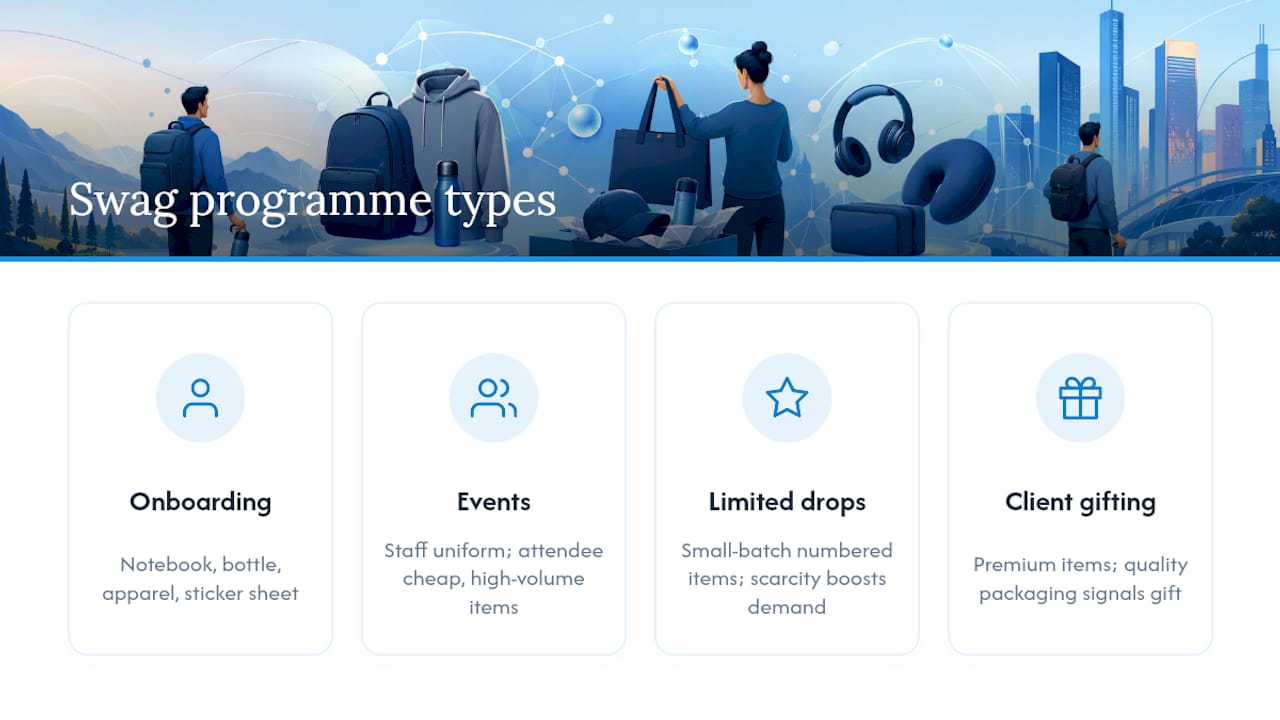
Onboarding kits should land on a new hire’s desk on day one, not week three. For a 50-person company, a workable kit runs a branded notebook, a quality water bottle, one piece of apparel in the person’s actual size, and a laptop sticker sheet. Timing matters more than contents here. A kit that arrives after someone’s first week already feels like an afterthought.
Event kits split into two tiers. Staff working the booth wear a consistent, higher-quality uniform piece, polos or branded jackets, while attendee giveaways run cheaper and higher-volume: stickers, bag tags, small desk items. Mixing these budgets up is the single most common event swag mistake; nobody needs a $40 hoodie budget stretched across 2,000 booth visitors.
Limited drops borrow directly from streetwear logic. A small-batch, numbered, or time-boxed item, think a launch-week hoodie or an anniversary bottle, creates real demand precisely because it won’t be restocked. Scarcity increases perceived value even when the manufacturing cost is identical to a standard-run item.
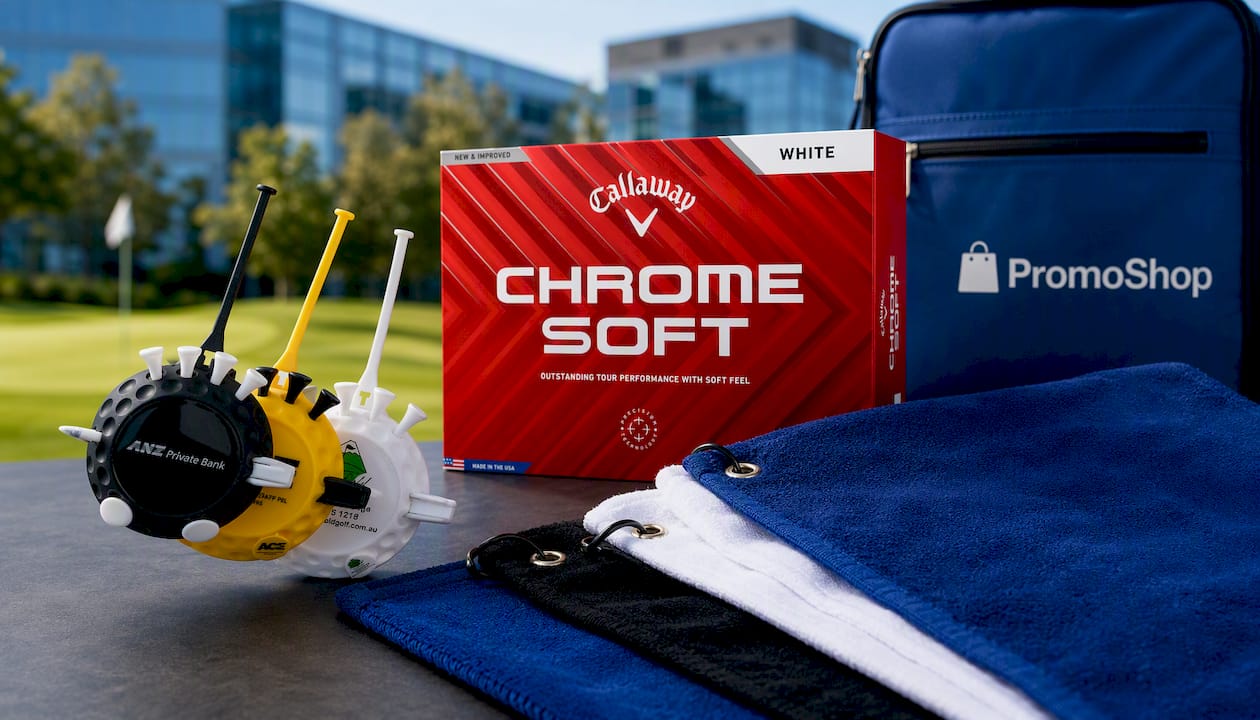
Client and partner gifting deserves its own budget line entirely. This is where premium items belong: a set of Callaway Chrome Soft golf balls in branded packaging for a client golf day, or a curated gift box for a renewal milestone. Packaging matters as much as the item here. A quality box with tissue paper reads as a gift; a courier satchel reads as an afterthought.
Sustainable swag that holds up under scrutiny
Sustainability claims on swag get scrutinised fast, especially by a tech audience that expects transparency. Recycled polyester in apparel, FSC-certified paper for notebooks, and organic cotton blends are the baseline signals worth checking on any supplier’s spec sheet before you commit to a print run.
Certification matters more than marketing copy. A brand partnership with a recognised body like One Percent for the Planet gives a giveaway or gifting programme a credible environmental tie rather than a vague “eco-friendly” label with nothing behind it. PromoShop’s guide to eco-friendly promotional products runs through specific certified options worth checking against your own supplier’s claims.
Durability is itself a sustainability decision, and it’s the one teams overlook most. A $15 stainless steel bottle that lasts five years beats three $5 plastic bottles that end up in landfill within a year, on cost and on waste. The same logic applies to packaging: bulk-ship to one office address instead of individually courier-packing each item, and cut the shrink wrap where a simple kraft box does the job. Reviewing the broader shift covered in PromoShop’s 2026 promotional merchandise trends shows sustainable sourcing has moved from a nice-to-have line item to a default expectation among younger recipients.
Communicate the sustainability angle plainly. A small tag noting the recycled content percentage or the certification body reads as credible. A vague “eco-friendly” claim with no specifics reads as marketing spin, and a tech-savvy audience notices the difference immediately.
Logistics, production and shipping notes for tech items
Production timelines catch more marketing teams out than budget does. Standard apparel and drinkware runs typically need a sample approval round before full production, and rushing that step is how a logo ends up off-centre on 500 units. Build in time for a physical sample check, not just a digital proof, before signing off on any order over a few hundred units.
Tech accessories carry the sharpest logistics risk in the entire swag category. Anything with a lithium battery, power banks, wireless chargers, some branded speakers, falls under freight and courier restrictions that vary by carrier and by destination country. Shipping guidance for tech giveaways flags region-locked warranties as a second, quieter problem: a power bank warrantied for one region may be unsupported if a recipient is based somewhere else, which turns a nice gift into a support headache.
Practical mitigations worth locking in before you order:
- Confirm battery-item shipping rules with your freight provider before committing to international quantities.
- Ask suppliers directly whether a warranty travels with the recipient or is tied to a specific region.
- Decide upfront who absorbs customs duties on international shipments, the giver or the recipient, and state it clearly if recipients are covering any cost.
- Choose central fulfilment (one bulk delivery to your office) for domestic events, and direct-to-recipient shipping only when the item and destination genuinely justify the extra courier cost.
Transparency here isn’t optional. Being upfront about shipping limits, warranty scope, and delivery timelines up front avoids the recipient dissatisfaction that follows a vague or overly optimistic promise.
How PromoShop supports tech swag programmes
Running a swag programme well means solving three problems at once: getting the design right, getting it delivered on time, and not overpaying for the privilege. PromoShop was built around exactly those three pressure points.
Every order includes free artwork design, which removes the single biggest bottleneck in most swag projects: a marketing or HR team without in-house design capacity trying to get a logo placement right on a curved bottle or a fitted hoodie. Getting that proof reviewed by someone who works in merch daily, rather than guessing from a flat mockup, is what prevents the off-centre logo problem covered above.
For teams working against a launch date or a conference deadline, Express service options handle the timeline pressure that catches many in-house teams out. Competitive pricing with guarantees gives budget-holders a genuine floor to plan against rather than a moving quote, backed by a factory-direct global supply chain with extensive industry experience.
The catalogue itself spans drinkware, apparel, bags, tech accessories, and corporate gifts, covering every category this guide has walked through, from onboarding basics to premium client gifting.
Editorial take: when swag is marketing and when it’s culture
The real skill in swag isn’t picking good items. It’s knowing which budget line an item belongs to. A public, high-volume giveaway and an employee-only premium piece are solving different problems, and blending their budgets is how companies end up with mediocre versions of both.
Ask one question before every order: is this meant to be seen by strangers, or felt by insiders? Reach favours volume and lower unit cost. Belonging favours exclusivity and quality. Chasing both with one item usually means quietly failing at both, and if there’s one instinct worth trusting here, it’s programme thinking over one-off ordering. Fewer, better items, matched deliberately to who’s actually receiving them.
— SEO
Get started with PromoShop
PromoShop’s advantage over piecing a swag order together yourself is straightforward: one supplier handles design, sourcing, and pricing certainty, so you’re not juggling a designer, a factory contact, and a freight quote separately.
Every order starts with free artwork design, so your logo placement gets checked by someone who works with curved bottles and fitted apparel daily, not guessed from a flat mockup. If you’re working against a conference date or a launch deadline, the express service is built for exactly that pressure. And the Price Beat Guarantee means the quote you get is a genuine floor, not an opening offer to negotiate down.
Start small if you’re testing the waters: a Small Golf Towel run for an upcoming client event, or a set of Corporate Bag Tags for your next conference booth, both give you a feel for turnaround and quality before committing to a full onboarding or gifting programme. When you’re ready to scope a bigger order, request a quote through PromoShop and get the free artwork design and Price Beat Guarantee working for you from the first draft.
Sources
- Free Giveaway Prize Generator | Get Prize Ideas Instantly
- Startup Swag Ideas 2026: Best Merchandise for Tech Companies | TBPN Blog | TBPN Merch Store
- One Percent for the Planet
FAQ
What is the best swag for tech companies?
Insulated drinkware and premium apparel top most lists because they get daily use, while tech accessories like chargers and cables score high for relevance but carry shipping restrictions worth checking first. The strongest programmes mix a durable everyday item with one higher-value piece reserved for employees or key clients, following the stage-appropriate quality approach that outperforms cheap bulk orders.
What are some good company swag ideas?
Onboarding kits with a bottle, apparel, and stickers work well for new hires, while stickers and desk items alone keep a community engaged cheaply, the same approach OpenAI and GitLab use in their own public merch shops. For client-facing moments, a premium item like branded golf balls or a well-packaged gift box performs better than a mass giveaway.
Which company gives the best swag?
There’s no single verified ranking here, but companies running visible public merch shops, including OpenAI and GitLab, are often cited as good examples because they treat swag as an ongoing programme rather than a one-off order. What sets strong swag programmes apart is consistency and quality control, not just budget size.
What are some good tech giveaway ideas for events and campaigns?
Match the item to your audience and goal rather than defaulting to a generic freebie. A giveaway prize generator approach, picking prizes by niche and budget, works for physical swag too, and pairing a useful item like a bag tag or bottle with a clear campaign goal drives better engagement than volume alone.
How much should a tech company budget for swag programmes?
Budgets vary widely by programme type: onboarding kits tend to run lower per person than premium client gifting, and event orders scale with headcount and item mix. PromoShop’s price-banded catalogue is a practical starting point for scoping a budget before requesting a full quote.