

September 18, 2026
Apparel, headwear, reusable drinkware, bags and one or two tech pieces cover most of the revenue a festival merch stand ever generates. Run a majority of stock as evergreen anchors, split the rest as tightly scheduled seasonal or limited drops, and test new items in small runs before committing to full production. Pre-orders reduce the risk of overstocking anything themed to a line-up that might change.
TL;DR:
- The majority of festival merchandise sales come from evergreen categories like apparel, hats, and reusable drinkware, which should be prioritized in the budget.
- Seasonal or hype items, such as artist collaboration pieces, should be produced as limited runs and pre-sold online to avoid excess stock and markdowns.
- High-traffic times like set changes require extra staff, real-time sales tracking, and clear exchange policies to maximize revenue and customer satisfaction.
- Licensing agreements are mandatory for artist or festival branding, and legal checks are vital to prevent counterfeit merchandise and protect intellectual property.
- Building anticipation through social media teasers, pre-sales, and staged reveals boosts on-site demand and reduces the risk of overstocking.
Table of Contents
- Festival merchandise ideas that sell, category by category
- Building your product mix: evergreen anchors vs seasonal hype
- What to look for in merch materials and suppliers
- On-site experiences that turn merch into an event
- Running the sales stand: staffing, display and inventory
- Considerations for licensing and copyright on band or festival logos
- Partnering with local artists and vendors for unique merch
- Building anticipation before the merchandise launch
- Legal and safety standards for festival merchandise
- Promoshop’s practical perspective on festival merch planning
- Get your festival merch sorted with a direct supplier
- Sources
- FAQ
Festival merchandise ideas that sell, category by category
Some products earn their spot on the table every year. Others exist to spike sales for a weekend and disappear. Knowing which is which before you order stock saves you from a warehouse full of unsold hoodies in March.
Apparel remains the backbone of any merch operation. T-shirts, hoodies and lighter onesie-style pieces cover the widest range of buyers, and a capsule collection tied to a specific stage or headliner adds a limited feel without overcomplicating production. For fast turnaround on core tee stock, a format like Pillow Pack – 55mm Tees lets you fulfil bulk apparel orders without the usual bottleneck, which matters when a festival sells 3,000 shirts across a single weekend and can’t afford a stockout on the Saturday.
Hats punch above their weight because they’re wearable branding that survives past the event. Snapback caps suit a younger crowd, bucket hats have held their place as a festival staple for a reason, and beanies extend the range into cooler regional events. Stick to breathable cotton twill or an acrylic knit blend rather than stiff synthetic material, since comfort under sun or wind is what gets a hat worn again the next weekend.
Bags and flags do double duty as both retail product and site signage. Tote bags are cheap to produce and popular as a “free with purchase over $50” incentive, while branded bunting strung across food courts and entry gates lifts the whole site’s visual identity. Car flags work well for festivals with camping components or long carpark walks, giving attendees a way to spot their group’s vehicle and giving the event another branding surface outside the gates entirely.
Drinkware has become close to mandatory at outdoor events, particularly where organisers are pushing reusable bottle policies. Insulated tumblers and stainless steel bottles justify a higher price point than plastic alternatives, and they double as a walking billboard for weeks after the event.
Sun protection and cooling items solve a real problem rather than just decorating a stall. Sunglasses, mineral sunscreen sticks, handheld fans and compact umbrellas move fastest during heatwave weekends, and pricing them as a bundle with a tote bag increases perceived value without discounting the individual items.
Impulse and collectible items fill the gap for attendees who want something but don’t want to spend $60. Stickers, enamel pins, posters and lanyards sit in the $5 to $15 range and work as natural add-ons at the register. According to one merchandise ideas roundup, these lower-cost categories capture buyers who’d otherwise walk past a $70 hoodie stand entirely.
Experience and high-visibility items round out a stronger assortment for multi-day or night-heavy festivals:
- LED and fibre-optic accessories that light up after dark
- Sound-reactive backpacks that respond to bass and crowd noise
- Hydration packs built for hands-free water carrying
- Anti-theft daypacks with modular attachment points for festival extras
Building your product mix: evergreen anchors vs seasonal hype
Evergreen items are the ones that sell regardless of who’s headlining. Caps, tote bags, sunglasses, reusable drinkware and umbrellas fall into this bucket, and they exist to keep cash flowing steadily across the weekend. Seasonal or hype items are tied to a specific line-up, artist collaboration or theme, and they’re best treated as limited runs rather than core stock, since demand for a “2026 headliner” shirt evaporates the moment next year’s poster drops.
A sensible starting split looks like this:
- Allocate 60 to 70% of your unit budget to evergreen categories that will still sell at next year’s event with a logo swap.
- Put 30 to 40% into seasonal or artist-collaboration pieces, printed in smaller batches so they sell out rather than get marked down.
- Pre-sell a portion of both categories online before doors open, which gives you real demand data before you commit to reprints.
- Reserve a small VIP-only or limited-edition run for the final batch. Scarcity tactics tied genuinely to the event create urgency that a generic reprint never will.
Pro Tip: Bundle a seasonal item with an evergreen one, like a limited tee paired with a reusable bottle, and price the pair just under the cost of buying both separately. It lifts average order value without looking like a markdown.
What to look for in merch materials and suppliers
The blank you print on decides whether your merch gets worn twice or twenty times. Mid-weight ringspun cotton tees and French terry hoodies feel noticeably better than the thin, scratchy stock some suppliers push as a cost-saving measure, and festivals that invest in retail-quality blanks see stronger repeat wear and fewer complaints at the till.
Sourcing decisions worth locking in before you order:
- Ask suppliers for fabric weight and composition, not just a photo of the garment.
- Request certification cues (organic cotton, recycled polyester) if sustainability is part of your event’s branding. Promoshop’s eco-friendly promotional products range is a useful reference point for what to ask for.
- Confirm minimum order quantities and lead times early. Express production options exist but usually cost more per unit.
- Run a quality check on incoming stock: check stitching, print alignment and colour consistency on a sample batch before the full shipment ships to site.
On-site experiences that turn merch into an event
Live customisation stations do more than fill dead time in a queue. Screen printing or embroidery done in front of the buyer turns a plain purchase into something they watched being made, and that shift from transactional to experiential regularly supports a higher price point than a pre-printed equivalent.
Tech-driven items add a second layer of spectacle, particularly after dark:
- LED and fibre-optic bags, including sound-reactive drawstring backpacks, make attendees into walking billboards once the sun goes down.
- Hydration packs built with 1.5 to 2.0 litre bladders and anti-theft pockets appeal to attendees moving through big crowds for hours, and the modular attachment points on festival-specific designs make them genuinely useful rather than novelty.
- Battery charging and washable-care instructions need to travel with every LED product, since a dead battery or a ruined circuit board turns a hero item into a refund request.
Pro Tip: Treat battery logistics as part of the product cost, not an afterthought. Budget staff time for charging stations overnight and print care instructions directly onto a swing tag.
Running the sales stand: staffing, display and inventory
A cluttered fold-and-stack table undersells good merch. Folded, lit, grid-walled displays lift conversion because they signal a proper retail experience rather than a fundraiser trestle table.
- Set up fast cashless lanes for high-volume items like tees and stickers, and staff a separate line for anything needing sizing help.
- Roster extra staff around headline set changes, when foot traffic through the merch tent spikes hardest.
- Track sales by SKU in real time, even with a simple spreadsheet, so you know by Saturday lunchtime what to restock and what to leave alone.
- Set clear exchange rules for sizing issues, but keep no-refund policies on anything opened or worn, which is standard for one-off events.
Considerations for licensing and copyright on band or festival logos
Using an artist’s name, likeness or logo on merchandise requires a licensing agreement, full stop. This isn’t a grey area organisers can talk their way around after the fact. Festival branding you own outright is straightforward to print, but anything referencing a headline act, including their logo, tour artwork or name in stylised text, needs written permission from the artist’s management or label before it goes into production.
Most festivals handle this through the artist’s booking contract, which should specify merchandising rights alongside performance fees. Some artists retain full control over their own merchandise and simply won’t allow festival-branded co-products at all. Others are open to a limited co-branded run, split on a royalty basis. Get this in writing before you commit to a print run, not after.
Trademark protection extends to the festival’s own name and logo too. If you’re licensing your event branding to a third-party merch partner or reseller, a simple licensing agreement protects you if that partner produces low-quality goods under your name. It also matters for enforcement: if counterfeit merch appears outside your gates (a common problem at larger events), a registered trademark gives you legal standing to act. Talk to an intellectual property lawyer before your first major event if band collaborations are part of your merch plan, since the cost of that conversation is far lower than an infringement dispute after the fact.
Partnering with local artists and vendors for unique merch
Some of the most memorable festival merchandise comes from outside the standard supplier catalogue entirely. A local illustrator commissioned to design a single limited tee gives you something a big-box print run can’t replicate, and it gives the artist paid exposure to a crowd they wouldn’t otherwise reach.
Structure these partnerships properly from the start. Agree on a flat fee, a royalty per unit sold, or a combination of both, and put it in writing before any artwork changes hands. Clarify who owns the final design files and whether the artist can reuse the artwork commercially after the event, since disputes over reuse rights are common when this isn’t specified upfront.
Local vendors extend the same idea into physical products. A regional print shop, a small-batch enamel pin maker, or even a food and drink vendor collaborating on branded packaging all add texture to a merch offering that feels specific to your event rather than generic. Partner catalogues like Gadget Solutions’ event and promotional range show the breadth of category options worth exploring if you want inspiration beyond apparel and drinkware. Confectionery and edible favours are another underused lane. Toffee and similar treats work well as event favours when branded and packaged properly, giving you a lower-cost, high-margin add-on that doesn’t compete with your core apparel range.
Building anticipation before the merchandise launch
The best-selling item at your festival is often decided weeks before doors open, not on the day. Teasing a limited design on social media a fortnight out, showing a behind-the-scenes glimpse of production, or releasing a small pre-sale batch all create demand that converts to queue length on-site.
Email lists and ticket-holder databases are underused for this. A simple “merch drops Friday, first 200 orders get X” message to confirmed ticket buyers routinely outperforms a cold social post, because it reaches people who’ve already committed money to attending.
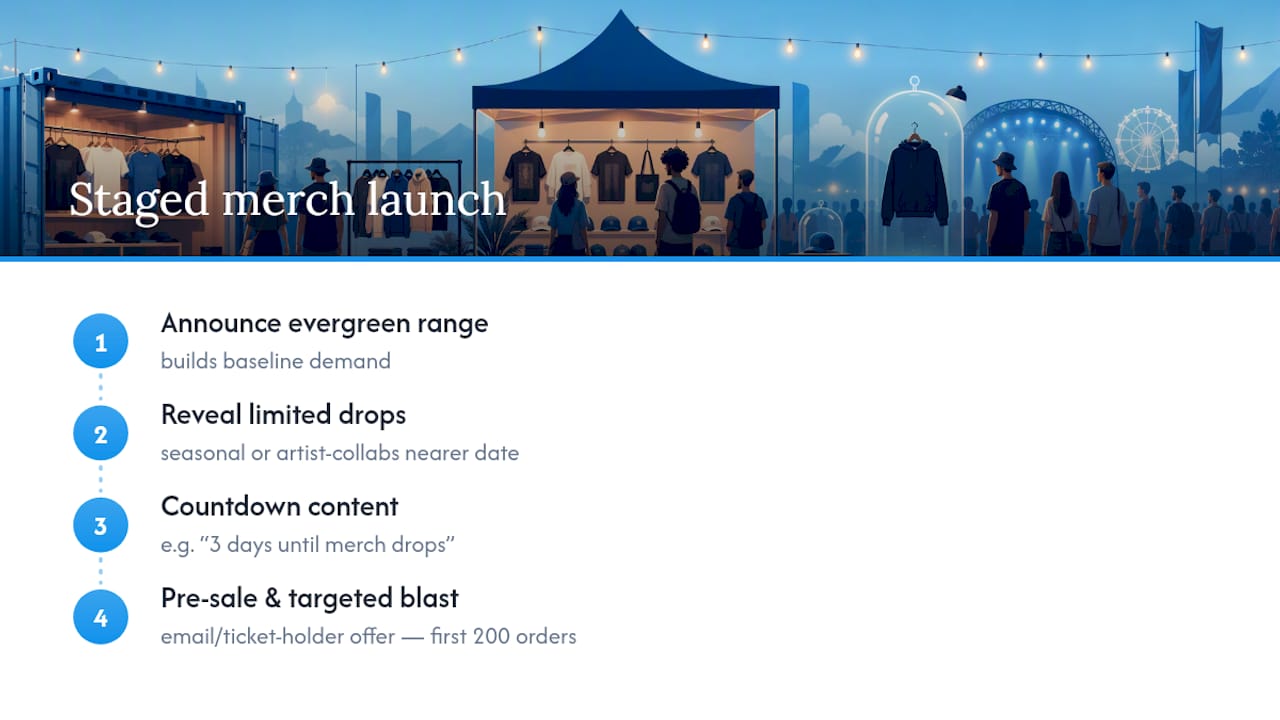
Consider a staged reveal instead of dropping the full range at once. Announce the evergreen range first to build baseline demand, then reveal the seasonal or artist-collaboration pieces closer to the date, which keeps the festival in people’s feeds for longer without exhausting the announcement in a single post. Countdown-style content (“3 days until merch drops”) works because it gives fans a reason to check back, and cross-promoting with any artists involved in a collaboration multiplies your reach into audiences you don’t otherwise touch.
Legal and safety standards for festival merchandise
Materials and labelling aren’t optional extras, they’re compliance requirements. Apparel sold in Australia needs to meet the mandatory fire safety labelling standards for clothing, and any children’s sizes carry additional flammability requirements that adult apparel doesn’t.
Check every supplier can provide care labelling, fibre content and country of origin information printed directly on the garment, not just on an invoice. This matters doubly if you’re working with an overseas factory-direct supplier, since customs and consumer law both expect this information to travel with the physical product.
Electronic or battery-powered merch, including LED and sound-reactive accessories, needs to meet relevant electrical safety standards before it reaches a buyer’s hands, and any lithium battery components should carry correct transport and disposal labelling. Don’t assume a supplier’s overseas certification automatically satisfies Australian requirements. If a product’s compliance documentation isn’t clear, ask before you order, not after a customer raises a safety complaint.
Food-adjacent or skin-contact items (sunscreen sticks, lip balm giveaways) carry their own separate regulatory requirements around ingredient labelling and allergen disclosure. Treat these as a specialised category requiring its own compliance check rather than folding them into your general merchandise order.
Promoshop’s practical perspective on festival merch planning
Most festivals overthink the creative brief and underthink the supply chain. The organisers who avoid stockouts and reprint panic aren’t the ones with the cleverest tee design, they’re the ones who locked in reliable production before the line-up was even finalised.
Promoshop has spent over 25 years supplying branded merchandise across Australia, combining a global supply chain with factory-direct sourcing to keep quality consistent without inflating cost. Free artwork design and a Price Beat Guarantee remove two of the most common friction points organisers hit: design costs blowing the budget, and rush orders costing double at the last supplier who’ll take the job.
— SEO
Get your festival merch sorted with a direct supplier
Skip the reprint panic that comes from working through three separate vendors for apparel, signage and giveaways. Promoshop supplies all three under one order, with a Price Beat Guarantee that protects your margin whether you’re stocking Pillow Pack – 55mm Tees for a 5,000-person crowd or a smaller run of bunting to dress the entry gates.
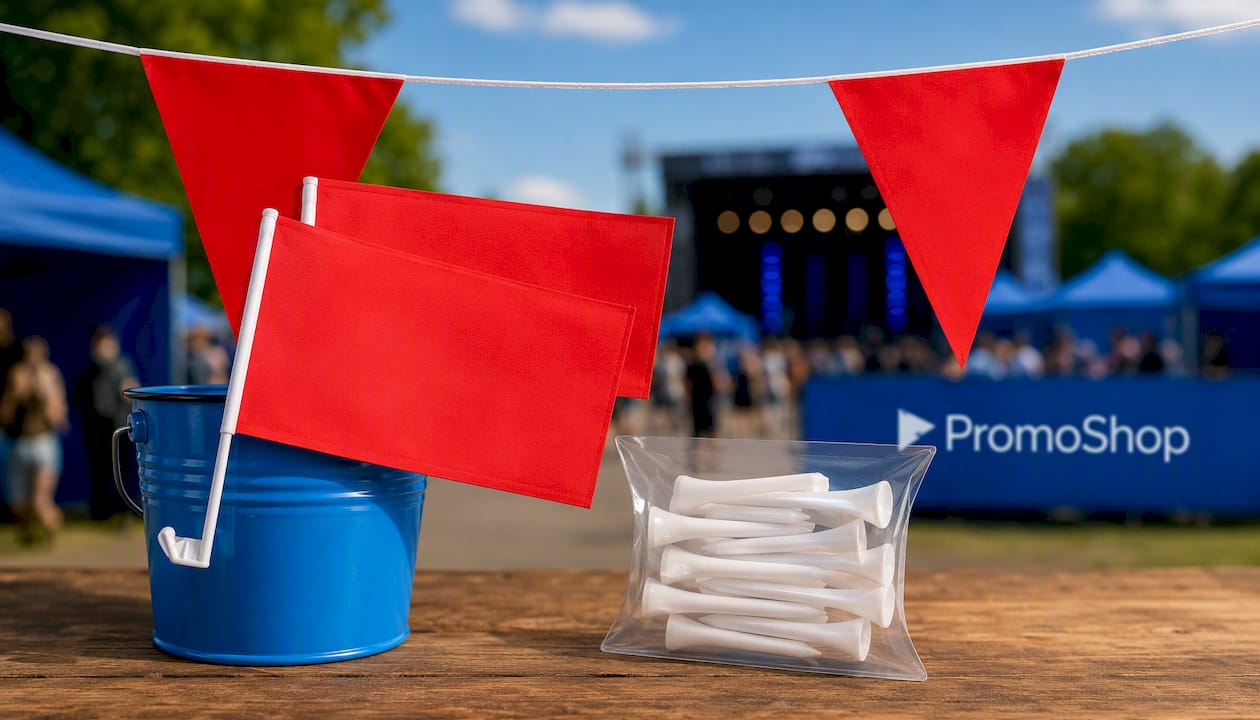
The Pillow Pack format handles bulk tee fulfilment without the usual bottleneck between design approval and delivery day, which matters when your merch tent needs stock by Thursday, not “sometime before the weekend.” Bunting and car flags extend your branding beyond the merch stand itself, covering entry points, food courts and car parks with the same visual identity attendees see on the shirts they just bought. Free artwork design means your team doesn’t need an in-house designer to get proofs sorted, and express service options can help when event details are confirmed later than typical print deadlines.
Head to Promoshop to request a quote, get your artwork proofed at no charge, or ask about express turnaround for your next event date.
Sources
- Best Festival Merchandise Ideas for 2026: Evergreen or …
- Merch masterclass: from eco tees to NFTs – how festivals sell out their merchandise
- NEBULITE Fiber Optic Drawstring Backpack - LED Sound Reactive
- Official merchandise ideas for music festivals: from souvenir to revenue product - Gopromo
FAQ
What sells well at a festival?
Apparel, caps, reusable drinkware and tote bags consistently outsell novelty items because they’re useful beyond the event weekend. Impulse items like stickers, pins and posters add strong margin on top of that core range, and a small batch of limited-edition or artist-collaboration pieces usually sells out fastest of all.
What are some festival must-haves for merchandise stands?
A well-stocked stand needs core apparel, headwear, reusable bottles, sun protection items and a handful of low-cost impulse buys like lanyards and stickers. Presentation matters as much as the product range. Suppliers such as Promoshop combine Pillow Pack – 55mm Tees for bulk apparel with signage like bunting to cover both retail and site branding in one order.
What are some good accessories for festival attendees?
Sunglasses, fans, compact umbrellas and hydration packs solve real comfort problems, which is why they move faster than purely decorative items. LED and fibre-optic accessories add a second wave of demand for night-heavy events, particularly sound-reactive backpacks that respond to the crowd around them.
What type of merch sells the most at concerts and festivals?
Apparel, specifically t-shirts and hoodies, typically drives the largest share of merch revenue because it appeals across every age group and price sensitivity. Headwear and reusable drinkware follow closely behind, with impulse items like pins and stickers adding volume rather than margin at the till.
How much of my merch budget should go to seasonal versus evergreen stock?
Pre-selling a portion of the seasonal batch before the event helps confirm real demand before you commit to a full print run.