

November 26, 2026
Australian hi vis clothing is covered by two main standards. AS 4602.1:2024 sets out the garment requirements. AS/NZS 1906.4 sets out the materials. If your team works near moving traffic, plant or equipment, you choose a garment class through a risk assessment, then buy garments that suit that result. We have written this guide for business owners, event planners and marketing teams who need to order branded hi vis and want to get it right the first time.
If you want to see what is available for branding, start with our Hi Vis Safety Vest for day time use. Then read on to learn how the standards work.
TL;DR
- AS 4602.1:2024 is the current garment standard for high-risk work. It replaced AS/NZS 4602.1:2011 in June 2024.
- AS/NZS 1906.4 covers the fabric and tape. AS 4602.1 covers the finished garment.
- Class D is for daytime. Class N is for night. Class D/N covers both.
- Choose a class through a risk assessment of the tasks, the place and the light conditions.
- Fluorescent material works in daylight. Retroreflective tape works at night. Neither one does both jobs alone.
Table of Contents
- Which standards apply to hi vis clothing
- The garment classes: D, N and D/N
- Fluorescent fabric and retroreflective tape
- What changed with AS 4602.1:2024
- How to choose hi vis for your team
- Checking a garment before you order
- Branding hi vis for your business
- Order hi vis with PromoShop
- Our view on hi vis standards
- FAQ
Which standards apply to hi vis clothing
Three standards come up most often when you buy hi vis in Australia. Each one covers a different part of the job.
| Standard | What it covers |
|---|---|
| AS 4602.1:2024 | High visibility safety garments for high-risk occupational use |
| AS/NZS 1906.4:2023 | The high visibility material used in garments, not the garment design |
| AS/NZS 4602.2 | Visual requirements for firefighters’ garments and ensembles |
Most businesses only need the first two. AS 4602.1 deals with the garment as a whole. AS/NZS 1906.4 deals with the fabric and tape that go into it. The materials standard covers daytime and low-light performance as well as night-time performance.
The Queensland Department of Transport and Main Roads shows how this works in practice. Its traffic controller clothing standard points to AS/NZS 1906.4 for the materials and AS/NZS 4602.1 for the high-risk garment design. It also points to AS/NZS 2210 for occupational footwear. So a compliant outfit is more than a bright vest.
Your state or territory work health and safety regulator, or your client’s site rules, may add requirements on top. Always check what the site or contract asks for before you order.
The garment classes: D, N and D/N
AS 4602.1:2024 sorts garments by when they will be seen. There are three use classes:
- Class D: daytime use.
- Class N: night-time use, where the wearer is seen by retroreflected light, such as vehicle headlights bouncing off tape.
- Class D/N: both daytime and night-time use.
The standard says you should choose the class through a risk assessment. That includes asking whether the work runs through daylight, darkness or low visibility.
A simple example helps. A landscaping crew that works 7 am to 3 pm in open daylight, near a quiet car park, has a daytime exposure. A crew that starts before sunrise on a roadside, or finishes after dusk, has both. The second crew needs a garment that works in both conditions.
The daytime option is often the right answer for event staff, warehouse teams and car park attendants who only work in daylight. Our day time use hi vis safety vest is made for that kind of use.
Fluorescent fabric and retroreflective tape
Hi vis garments use two types of material. They do different jobs.
- Fluorescent material typically provides visibility in daylight and low light.
- Retroreflective material typically provides visibility at night and in low light.
The standard notes that neither type alone generally gives conspicuity across both conditions. This is why a bright orange vest with no tape is a daytime garment, and why tape on a dark shirt is not a daytime solution.
The materials standard groups materials into classes:
| Material class | Meaning |
|---|---|
| F | Fluorescent |
| F(W) | Fluorescent, with an optional wet-weather test |
| R | Retroreflective |
| RF | Combined retroreflective and fluorescent |
| NF | Non-fluorescent high visibility |
| NF(W) | Non-fluorescent, with a wet-weather test |
| SP | Separate fluorescent and retroreflective components |
You do not need to memorise these. You do need to know that the label on a garment should tell you what material it uses. Retroreflected colour is not specified, so the key night-time requirement is retroreflective performance, whatever the tape colour looks like in the light.
Tape width in a real example
Tape sizes depend on the job. As one example, the Queensland traffic controller standard asks for retroreflective strips at least 50 mm wide, or two 25 mm strips. It allows narrower tape on headwear and gloves. That rule applies to traffic controllers in Queensland. Your own industry may have different needs, so check the rule for your own work.
What changed with AS 4602.1:2024
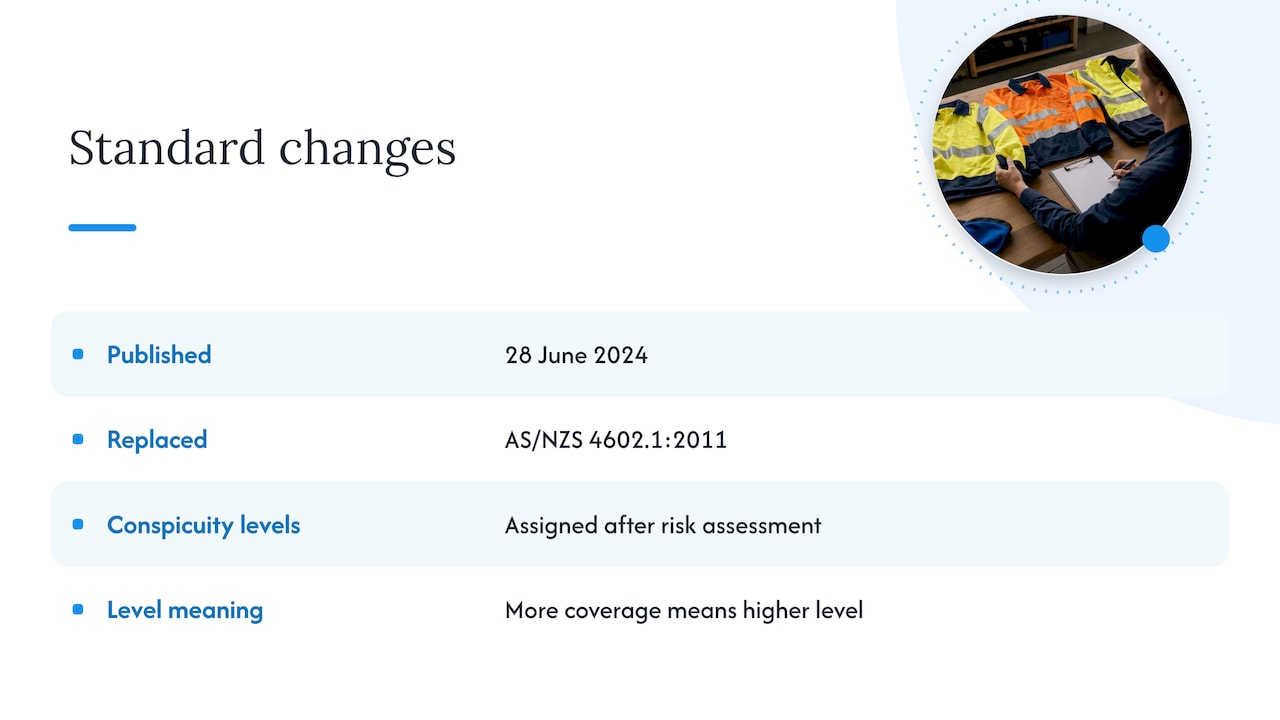
Standards Australia published AS 4602.1:2024 on 28 June 2024. It replaced AS/NZS 4602.1:2011. It was also developed as an Australian standard rather than a joint Australian and New Zealand one, which is why the prefix changed.
The main change is that each garment class now has conspicuity levels. These can be assigned after a risk assessment. In plain terms, the more of the body that is covered with high visibility material, the higher the level. This lets a business match the garment to the real risk instead of buying one design for everyone.
Some older guides and product pages still refer to the 2011 edition. When you read a product description, check which edition it names. If you are unsure which edition your workplace or client requires, ask your safety adviser or the site manager.
How to choose hi vis for your team
The standard asks you to look at the garment’s intended use and life. That means the wearer’s job, the place, the tasks and the risks. It also means daylight, night, low light and bad weather.
Transport for NSW gives a clear process in its 2024 PPE guidance. A risk assessment should identify tasks and locations. It should then select PPE for the risk that remains after other controls have been considered. Hi vis is the last layer, not the first.
The same guidance says fluorescent clothing is generally for the day and retroreflective materials for the night. For night work, fog, low light, tunnels or underground work, it says clothing should have retroreflective strips that meet the cited standards.
Use this short checklist:
- List the tasks. Who works near vehicles, plant or equipment?
- List the hours. Is any work before sunrise, after dusk or indoors in poor light?
- List the conditions. Rain, fog, dust, tunnels and shaded areas all matter.
- Pick the class. D for day only, N for night, D/N for both.
- Pick the level and garment type. Vest, shirt, jacket or trousers, based on how much coverage the risk calls for.
- Record your decision. Keep the risk assessment with your WHS records.
A worked example
A events company runs bump-in at a stadium. Crews arrive at 5 am and finish at 2 pm. Part of the work is in a loading dock with forklifts. The hours include darkness and the dock is dimly lit. The risk assessment points to Class D/N. The company chooses a garment with both fluorescent fabric and retroreflective tape. The company’s admin staff in the office need none.
That last point matters for budget. A risk assessment tells you who needs a compliant garment and who does not, so you spend only where it counts.
Checking a garment before you order
The standard asks you to confirm that a garment is made for high-risk occupational use under AS 4602.1:2024, and that you have chosen it through a risk assessment for its intended use and life. In practice:
- Look at the class on the product page: D, N or D/N.
- Look for the edition of the standard. The current one is AS 4602.1:2024.
- Check the material details, including whether it has fluorescent fabric, tape or both.
- Check the garment label on arrival.
- Keep the product details with your risk assessment.
Hi vis is not only for traffic work. Many businesses also order it for events, volunteers, school crossings, warehouses and promotions. Where the garment is a safety garment for a high-risk job, follow the standard. Where it is a visibility item for a lower-risk setting, the same bright colours still help your team stand out.
Branding hi vis for your business
A hi vis garment with your logo does two jobs. It keeps people visible and it puts your name in front of the public. Plan the branding with the garment in mind.
- Send your logo as a vector file. Our logo file formats guide explains which one to send.
- Use our artwork guide to prepare your design. We offer free artwork design if you need help.
- Read the branding guide to compare ways to apply a logo.
Our hi vis range includes more than vests. You can look at the Mens Hi Vis X Back Taped Shirt, the Mens Rugged Cooling Hi Vis Spliced Shirt and the Hi-Vis Two Tone Kangaroo Pocket Hoodie. If you want hi vis as part of a wider uniform, see our promotional clothing range. Add caps and headwear to finish the look.
Order hi vis with PromoShop
We supply custom branded hi vis clothing to Australian businesses. Our offer includes custom branding, free artwork design and an express service for tight deadlines. We source factory-direct through a global supply chain, and our Price Beat Guarantee applies to all products.
If you know your class and quantity, send us the details and we will guide you from there. Get in touch through our home page.
If you are still planning a wider merchandise order, our promotional merchandise buyer’s guide covers the basics.
Our view on hi vis standards
We see hi vis as both a safety item and a brand item. The best order starts with the risk assessment, not the logo.
Decide first who needs a Class D, N or D/N garment. Then decide how your brand sits on it. That order keeps your team safe and keeps your spend sensible.
We offer free artwork design, express service and a Price Beat Guarantee. Our factory-direct sourcing is built to give you consistent quality at competitive prices. That means you can outfit a crew without overspending, and keep a clean, consistent look across every worksite.
Hi vis is one part of a wider uniform. We can help you add shirts, hoodies and caps in matching branding, so your whole team looks like one business.
PromoShop
FAQ
What is the current hi vis standard in Australia?
The current garment standard is AS 4602.1:2024, published on 28 June 2024. It replaced AS/NZS 4602.1:2011. The material standard is AS/NZS 1906.4, and its latest edition is the 2023 one.
What is the difference between Class D, Class N and Class D/N?
Class D is for daytime use. Class N is for night-time use, seen by retroreflected light. Class D/N covers both. You choose between them through a risk assessment of the work, including whether it runs through daylight, darkness or low light.
Do I need retroreflective tape on every hi vis garment?
Not always. Fluorescent material typically gives daytime and low-light visibility. Retroreflective material typically gives night-time and low-light visibility. If your work involves night, fog, tunnels or low light, Transport for NSW guidance says clothing should have retroreflective strips. Your risk assessment decides the rest.
Can I put my logo on a hi vis garment?
Yes. Hi vis is a popular branded item for trades, events and services. Send us your logo and we can arrange the branding, with free artwork design if you need it. Plan the design around the garment so the logo suits it.
Who decides which hi vis class my workers need?
Your business does, through a risk assessment under your work health and safety duties. For complex sites, ask your WHS adviser or your state regulator. Then bring your chosen class to us and we will help you find a matching garment to brand.