


October 30, 2026
The best finance giveaways are useful, modest in value and easy to link to a money habit. Think piggy banks, card wallets, pens, calculators, drink bottles and small gifts for a branch opening or seminar. Pick items your customers use every week, keep the cost low per person, and check the ASIC and ACCC rules before you hand anything to advisers, brokers or referrers.
This guide is for banks, credit unions, mortgage brokers, accountants, advisers and fintechs. It covers what to give, who to give it to, how to set a budget and what to check first.
TL;DR
- Choose items that sit in a wallet, on a desk or in a bag: card holders, pens, notebooks, bottles, calculators and piggy banks.
- Tie the giveaway to an action, such as opening an account, attending a seminar or finishing a savings challenge.
- Keep client gifts low in value. ASIC treats non-monetary benefits under $300 per person, given infrequently, differently from larger or regular ones.
- Do what you promise. The ACCC says free gifts must be provided as advertised, with no hidden costs.
- Match the item to the audience: a $1 pen for a street stall, a leather pouch for a top client.
Table of Contents
- What makes a finance giveaway work
- Everyday items for banks, credit unions and brokers
- Giveaways by budget
- Giveaways that tie to an action
- Rules to check before you give anything away
- How to choose and distribute your giveaway
- Common mistakes
- Our view on finance giveaways
- Order your finance giveaways with PromoShop
- FAQ
- Sources
What makes a finance giveaway work
Finance is a trust business. People hand you their savings, their mortgage and their super. A giveaway that looks cheap or gimmicky works against that.
A good one does three things.
- It gets used. A pen on a desk or a card holder in a wallet puts your name in front of the customer many times.
- It fits the message. Saving, planning and protecting all have natural objects.
- It looks careful. Clean branding, sound quality and a sensible size say you run a careful business.
A giveaway that is novel but useless goes in a drawer. Ask one question before you order: would your customer buy this for themselves?
Everyday items for banks, credit unions and brokers
These are the staples. They are not exciting, but they are reliable, and they suit counters, branch openings and community stalls.
Piggy banks and savings tools
A piggy bank is the classic bank giveaway because the message is built in. It suits children’s savings accounts, school visits and family days. Browse promotional piggy banks for options that can carry your logo.
Other savings-themed items include coin banks, money boxes and budget notebooks. Add a short prompt on the item, such as a savings goal line, so it does a job as well as carrying your name.
Card holders, wallets and valuables pouches
Customers handle cards, licences and keys every day. A card holder or small wallet fits that habit. It also suits identity-protection messaging, which is useful when scams are a concern.
For clients you want to thank properly, a premium leather valuables pouch works well. It is a quiet, practical gift for a top client, a new business customer or a long-standing referrer.
Pens, notepads and calculators
Pens are still the item people expect at a signing. Customers sign loan documents, forms and cheques, so a good pen is used on the spot. A comfortable, reliable pen suits the setting far better than a flimsy one.
Desktop calculators, sticky notes and notepads suit tax time. Accountants and bookkeepers can hand these to small business clients in the weeks before lodgement.
Drinkware and bags
Bottles and bags travel. A Trail Bottle goes to the gym, the office and the school run, so your brand is seen in places a brochure never reaches. Tote bags suit seminars, where attendees need something to carry papers in.
Confectionery
Branded mints and lollies suit counters and reception desks. They cost little and suit a high volume of walk-in visits. They do not last, so use them as a welcome, not as the main giveaway.
Giveaways by budget
A budget tier stops you giving a premium gift where a simple one will do. PromoShop has price-led pages that help you plan: products under $1, under $2, under $5, under $10 and under $50.
| Audience | Occasion | Item types to consider |
|---|---|---|
| Walk-in customers | Counter, community stall | Pens, mints, magnets, sticky notes |
| Families and children | School visits, family days | Piggy banks, stationery sets, small novelties |
| Seminar attendees | Retirement, first home buyer or tax events | Notebooks, tote bags, pens, lanyards |
| New account holders | Welcome pack | Card holders, bottles, calculators |
| Top clients | End of year, anniversary | Leather pouch, premium drinkware, desk items |
| Business clients | Tax time | Calculators, planners, desk organisers |
Order in bulk for the low tiers and in small, careful runs for the top ones. A premium gift only feels premium if it is given with some thought, so write a short personal note.
Giveaways that tie to an action
An item handed out with no purpose is a cost. An item linked to an action is a campaign. Australian finance brands show how this can work.
Make saving a game
The digital bank Up turned the back of its bank-card mailer into a 52-week savings challenge, built to make saving fun and encourage better habits. You can use the same idea with a branded notebook, a savings tracker card or a piggy bank that arrives with a simple weekly plan.

Tie the giveaway to financial education
Broker Daily reported that the lender ME gave away 50,000 Easter eggs and ran a live egg hunt with a $1,000 reward, to send people to its online School of Money. The gift was the hook. The lesson was the goal.
A smaller business can do this on a smaller scale. Hand out a branded notepad at a budgeting workshop, with a QR code to a free guide.
Offer an experience, not just an item
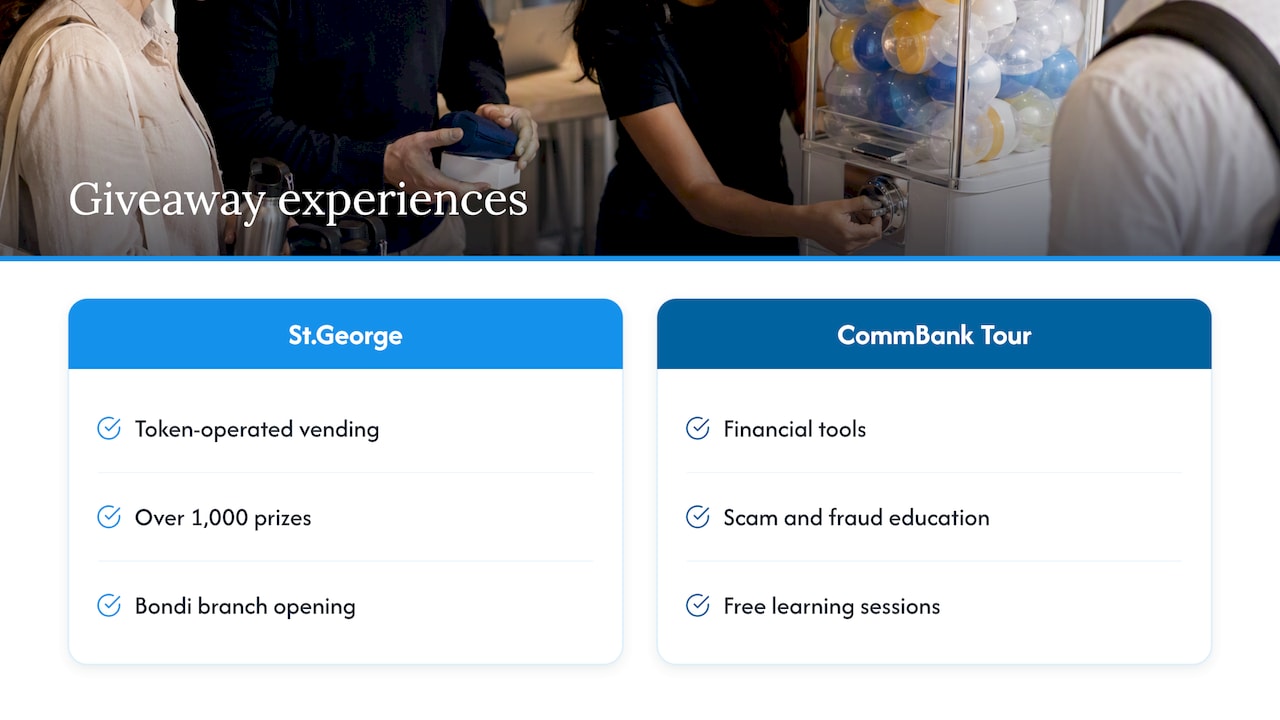
St.George Bank used a token-operated vending machine to give out over 1,000 prizes at a Bondi branch opening. It made staff welcome in the community. The lesson for a local office is simple: a branch opening, a community day or an anniversary is a good moment to give something with a bit of surprise.
CommBank takes another approach with its CommBank Tour, which offers financial tools, scam and fraud education and free learning sessions. Not every business can run a tour. But a short free session with a small branded take-home item follows the same logic.
Build a referral loop
A thank-you gift can sit inside a referral scheme. If you want to see how a structured referral launch is planned, this guide to a referral program build walks through the steps. If you do this in financial services, read the rules below first, because referral rewards sit closer to the regulated area than a pen at a stall.
Rules to check before you give anything away
Finance is regulated. A giveaway that is fine for a cafe can be a problem for an adviser. This section is a starting point. It is not legal advice. If you hold an Australian financial services (AFS) licence, talk to your compliance team or a financial services lawyer before you run a campaign.
Gifts to advisers, brokers and referrers
Under the Corporations Act, a benefit given to an AFS licensee or representative who provides financial product advice to retail clients is conflicted remuneration if it could reasonably be expected to influence the product chosen or the advice given.
There is an exception for small non-monetary benefits. ASIC’s Regulatory Guide RG 246 says a non-monetary benefit is generally excluded only when its value is less than $300 per recipient and identical or similar benefits are not provided frequently or regularly. Benefits from $100 to $300 must be recorded.
The same guide says the giver, timing, purpose, value and features all matter when assessing whether a benefit could influence advice or product choice. ASIC’s insurance commission FAQ adds that a benefit can still be conflicted remuneration in other circumstances, even if it is under the threshold.
In practice:
- A branded pen or notebook for a broker is low risk, but still keep a record.
- A gift of $100 or more needs a record.
- Do not give the same broker a steady stream of gifts.
- Do not link a gift to the volume of products they sell.
The risk is higher with larger rewards. In 2022 the Federal Court dealt with a case where non-monetary benefits such as holiday packages and cruises for sales agents were found to be conflicted remuneration. A thank-you pouch is nothing like that, but the principle is the same.
Gifts to the public
The Australian Consumer Law applies to every business. The ACCC says businesses cannot offer free gifts to promote sales if they do not intend to provide them, fail to provide them as promised, or add hidden delivery costs without telling people first.
So:
- Say clearly what the gift is and who qualifies.
- Order enough stock for the number of people you have promised.
- State any condition up front, such as one per household.
- Do not imply people have won a prize when they have not. The ACCC took action in 2024 over misleading prize promotions by a direct mail company.
If you run a competition with a prize draw, state and territory permit rules may also apply. Check with the relevant state body before you launch.
Clear marketing
Direct marketing codes ask for plain, unambiguous offers and clear business contact details. A draft ADMA direct marketing code from 2005 says this, and it is still good practice. Put your full company name and contact details on any mailer that carries a giveaway offer.
How to choose and distribute your giveaway
Follow these steps.
- Set the goal. Is it new accounts, event attendance, referrals or client retention? One goal per campaign.
- Define the audience. Public, existing clients or professional partners. The rules above differ for each.
- Set a per-person budget. Then check it against the $300 line if any recipient is an adviser or broker.
- Pick the item. Choose what the person uses weekly. Ask staff what they would keep.
- Design it simply. A logo, a short line and your contact details. Clean branding looks trustworthy.
- Plan the handover. Give it at a meaningful moment: account opening, a seminar, a milestone.
- Order early. Allow for artwork approval, production and delivery, and add a buffer for events.
- Keep records. Log who received what and when, especially for professional recipients.
- Measure it. Use a QR code or a unique URL on the item to track responses.
For more ways to stretch a small budget, see our guide to promotional product ideas for Australian SMEs.
Common mistakes
- Giving too much. An expensive gift can feel like a bribe, and for professionals it can create a compliance problem.
- Choosing novelty over use. Stress balls shaped like dollar signs are fun once. A good pen is used for years.
- Ignoring the audience. Seniors, students and business owners want different things.
- Forgetting follow-up. A giveaway with no next step wastes the contact. Add a QR code or a call to action.
- Leaving it too late. Rushed orders mean compromises on quality.
Our view on finance giveaways
We have supplied promotional products to Australian businesses for over 25 years. Finance clients ask us the same thing: what will people keep?
Our answer is practical. Choose items that do a job. Keep branding neat. Spend less per head and give to more of the right people. A good pen, a sturdy bottle or a card holder will stay in use long after a fancy novelty is gone.
We source direct from factories through a trusted global supply chain. That helps keep quality consistent and prices competitive, which matters when you order in volume for a branch network or a seminar series. Our free artwork service means your logo is set up properly before production, so you do not need a designer on call. And if you find a lower price on the same product, our Price Beat Guarantee applies.
One more point. The compliance rules above are your responsibility, and you know your licence conditions best. We can help you pick items that suit a modest budget, and we will not push you to spend more than you need.
— PromoShop
Order your finance giveaways with PromoShop
We offer custom branding, free artwork and express service across categories that suit finance teams, including pens, drinkware, bags, office items, corporate gifts and awards, and clothing. Tell us your audience and your budget, and we will suggest items that fit.

Start at PromoShop and get in touch with our team. We are here to assist.
FAQ
What is a good low-cost giveaway for a bank?
Pens, magnets, notepads and mints work well at a counter or stall. Piggy banks suit children and family events. Check the price pages for items under $1, $2 and $5 to plan a large run.
Can I give gifts to mortgage brokers or financial advisers?
Yes, but take care. ASIC’s RG 246 generally excludes non-monetary benefits only when they are under $300 per recipient and not frequent or regular. Benefits of $100 to $300 must be recorded. Speak to your compliance team or a financial services lawyer before you set up a programme.
What should I give top clients at the end of the year?
Choose a quality, useful item such as a leather valuables pouch, premium drinkware or a desk item. Add a personal note. Keep the value modest and consistent across clients.
Do I have to supply the gift I advertise?
Yes. The ACCC says businesses cannot advertise free gifts they do not intend to provide or fail to provide as promised. Order enough stock, state the conditions clearly and avoid hidden costs for the customer.
How do I know if a giveaway worked?
Put a QR code or a unique web address on the item or on the card that comes with it. Count scans, sign-ups or appointments. Compare against the number of items you gave out.
Sources
- Deliver bank card; melt faces (Up)
- Challenger bank giveaway promotes financial literacy (Broker Daily)
- St.George Vending Machine
- Welcome to The CommBank Tour
- Future of Financial Advice: Conflicted remuneration (ASIC)
- Regulatory Guide RG 246 (ASIC)
- FAQs: Informed consents for insurance commissions (ASIC)
- Federal Court of Australia judgment (ASIC)
- Cash back offers, gifts and prizes (ACCC)
- ACCC v Magnamail concise statement
- Direct marketing code of practice (draft)
- Referral program guide