


November 29, 2026
If your business is registered for GST and you buy a branded gift for a client, supplier or contractor, you can generally claim back the GST in the price. The gift must not be entertainment, and you must hold a valid tax invoice. Gifts for staff follow the same GST logic, with one extra check: fringe benefits tax (FBT). Below, you will find the rules in plain words, a worked example and the records to keep.
Branded merchandise is an easy category to get right. A pen, a tote bag or a jacket with your logo is a take-home item, not a night out. That is what the tax rules care about. If you want to see what sits in that category, our corporate gifts and awards range is a good place to start.
TL;DR
- A GST-registered business can claim a GST credit on gifts bought for business purposes if the price included GST and it holds a tax invoice for purchases over $82.50.
- Take-home gifts such as branded merchandise, hampers and flowers are non-entertainment. Tickets, meals and hosted drinks are entertainment, and they earn no credit.
- Gifts to clients carry no FBT. Gifts to employees may, depending on the value and how often you give them.
- The GST credit on a GST-inclusive price is one eleventh of that price. A $220 gift gives a $20 credit.
- Keep the invoice, the recipient, the business reason and the date. Records are kept for five years.
Table of Contents
- How GST works on a gift you buy
- Gifts to clients and suppliers: the entertainment line
- A worked example
- Gifts to employees: GST and FBT together
- Gift cards are different
- Records that protect your claim
- Giveaways with conditions attached
- Donations and fundraising
- Choosing gifts that keep your tax simple
- Our view
- Order your branded gifts with PromoShop
- FAQ
How GST works on a gift you buy
GST is 10% added to most goods and services in Australia. When you buy something for your business, the supplier charges you GST. If you are registered for GST, you can claim that amount back on your Business Activity Statement (BAS), the form you lodge with the ATO to report GST.
A gift you give away is a bit different from a sale. You receive no payment, so you do not charge GST on it. But you did pay GST when you bought it. That part is claimable.
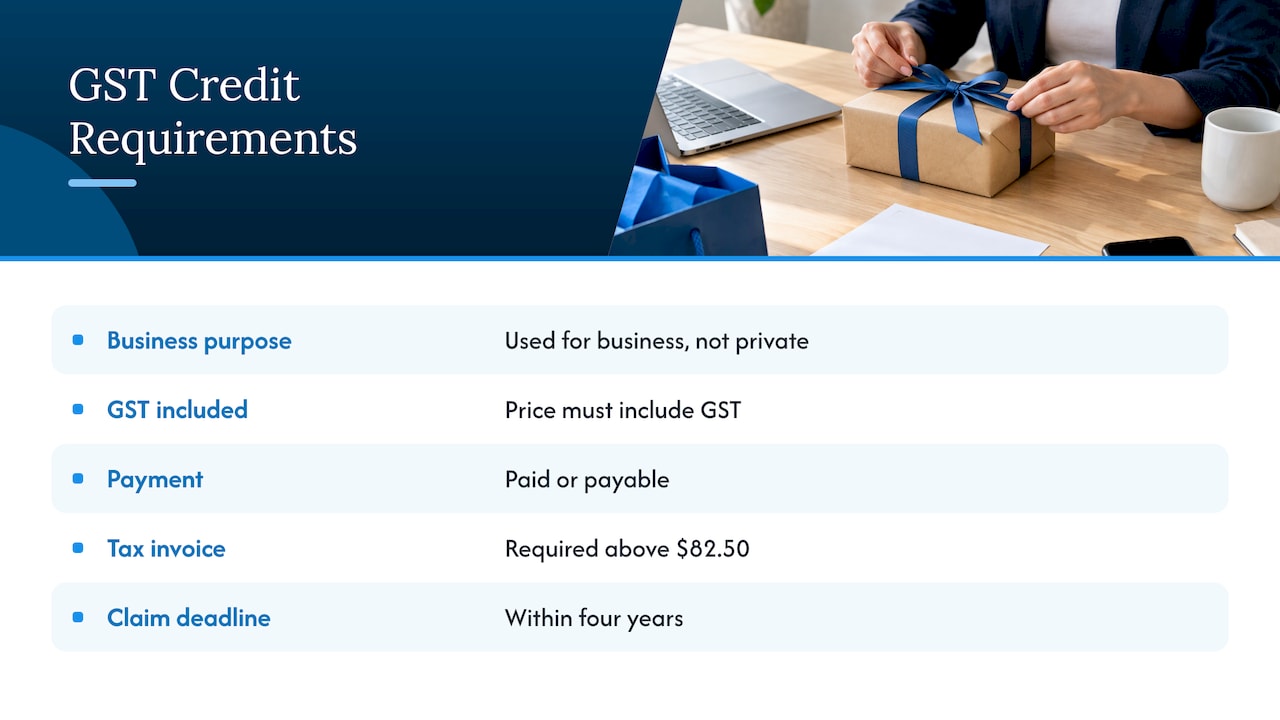
The ATO sets out four conditions. The purchase must be for a creditable purpose, meaning it is used in your business and is not private. The price must include GST. You must have paid or be liable to pay. And you must hold a tax invoice if the purchase is over $82.50. All four are on the ATO page When you can claim a GST credit. The same page sets a four-year time limit on claims.
You also need to be registered. A business that is not registered for GST cannot claim credits, and a supplier who is not registered will not have charged you any.
Gifts to clients and suppliers: the entertainment line
For client gifts, one question decides the GST outcome: is the gift entertainment?
The ATO says you cannot claim a GST credit on purchases that cannot be deducted for income tax, and entertainment is the usual example. See When you can’t claim a GST credit.
In practice, this splits gifts into two groups.
| Gift type | Examples | Deduction | GST credit |
|---|---|---|---|
| Non-entertainment, taken away | Branded merchandise, pen sets, hampers, flowers, a bottle of wine to take home | Generally yes | Generally yes |
| Entertainment | Concert or sports tickets, restaurant meals, hosted drinks | No | No |
The split is explained by one ATO ruling on gifts. LDB Group’s festive guide cites Taxation Determination TD 94/55 for the test: a gift is not entertainment if the recipient takes it away and enjoys it later, with no immediate consumption.
That is why the item decides the outcome, not the occasion. Aevum Accounting gives a neat example. At one Christmas party, a bottle of wine handed to a client at the door can be deductible and GST-creditable. The glass poured inside the party is entertainment, with no deduction and no credit.
Branded merchandise sits clearly on the right side of that line. A logo mug, a notebook or a cap is something a client keeps and uses. Sageon’s scenarios include a $250 branded merchandise client gift, which is deductible with a GST credit and no FBT.
There is no $300 cap on client gifts. The $300 figure belongs to the FBT rules for employees. For clients, a non-entertainment gift is claimable whatever it costs, as long as it is a genuine business expense. Interactive Tax Consultants makes this point directly.
One caution applies to high-value technology. H&R Block notes that capital items for clients, such as tablets, are not deductible, and the GST cannot be claimed on them. Everyday branded products are a different matter.
A worked example
Say you order 100 branded drink bottles for clients at $2.20 each, GST included. The total is $220.
- The GST in a GST-inclusive price is one eleventh. $220 divided by 11 is $20.
- You claim $20 as a GST credit on your BAS for the period.
- The cost to your business is $200 before income tax.
- You hold the tax invoice, since the total is over $82.50.
- You record who received them and why.
If the bottles go to a client event as items people take home, the result is the same. If you hand out the same bottles to staff, check the FBT section below.
A larger example comes from HelloLedger. It describes 40 hampers at $150 each, a $6,000 spend, with a GST credit of about $545. The example assumes the full price includes GST and the business can claim it.
Gifts to employees: GST and FBT together
FBT is a tax paid by employers on certain benefits given to employees. Gifts to clients are never subject to it. Gifts to staff can be.
The ATO page on FBT and festivities confirms that benefits to business clients are not subject to FBT. It also confirms that infrequent employee gifts under $300 per person can be minor benefits, which are exempt from FBT.
For GST, the same split applies as with clients:
- Non-entertainment staff gift under $300, irregular: no FBT, deductible, GST credit claimable.
- Non-entertainment staff gift over $300: FBT applies. It remains deductible, and the GST credit is available. Knight Group notes that the credit is claimable once FBT is paid.
- Entertainment gift under $300: no FBT, but no deduction and no GST credit.
Two traps are worth knowing. The $300 test looks at how often you give, not just the value of each gift. HelloLedger warns that a monthly voucher, a birthday gift and a Christmas gift can together lose the exemption, even if each one is under $300. And the cap applies per benefit, as Wimmera Mallee Accounting explains.
If you are unsure how FBT applies to your staff gifts, speak to your accountant or registered tax agent before you order. They can check the facts of your situation.
Gift cards are different
Many people assume a gift card brings a GST credit. It does not work that way at the point of purchase.
The ATO’s page on GST and vouchers explains that selling a face-value voucher at or below its face value is not a taxable supply. GST is accounted for when the voucher is redeemed. So there is no GST on the card when you buy it, and nothing to claim then.
A gift with your logo on it avoids this confusion. You pay GST on the product, you receive a tax invoice showing it, and the credit is simple to calculate.
Records that protect your claim
A claim is only as good as the paperwork behind it. Keep these for each gift purchase:
- The tax invoice for any purchase over $82.50, GST included. For $82.50 or less, the ATO accepts a receipt, docket or similar record showing the supplier’s name and ABN, the date, a description and the amount paid.
- The recipient and their relationship to your business, such as client, supplier or employee.
- The business reason, for example a thank-you after a completed project.
- Whether the gift is entertainment. The ATO asks you to identify non-deductible purchases in your records at G15 on the BAS, as set out in Completing your BAS for GST.
- The date and the cost including GST.
The ATO requires you to keep BAS records for five years in writing and in English. If a supplier’s invoice is missing details, you can ask them for a corrected one. Suppliers have 28 days to issue a tax invoice you request.
Code each purchase when you pay for it. Setting up separate accounts for client gifts, staff gifts and entertainment makes the BAS far quicker later. In some trades, buyers also issue invoices on the supplier’s behalf, and the rules for recipient created tax invoices are worth knowing if that applies to you. For ordinary merchandise orders, the supplier’s tax invoice is all you need.
Giveaways with conditions attached
Some promotions are not pure gifts. If you give something in return for a purchase, a referral or a promise of future business, the item may be part of a sale. The Australian GST & Tax Glossary notes that a free item with a purchase generally forms part of that sale, not a separate gift.
This matters for the reader running a promotion. A giveaway at a trade stand with no strings attached is a genuine gift. A free item that comes with a purchase changes how the sale is priced and reported. If your promotion has conditions, ask your accountant how to treat it on your BAS.
Donations and fundraising
If you are a not-for-profit giving or receiving gifts, different rules apply. The ATO states that a donation where the donor gets no material benefit is not payment for a supply, so no GST applies. If a material benefit is provided, GST of one eleventh is payable if the organisation is registered or required to be. This guide is about business gifts, so the detail stays with the ATO.
Choosing gifts that keep your tax simple
A few habits make gifting easy to claim.
- Choose take-home items. Branded apparel, pens, drinkware and bags are used later, away from your event. See our promotional clothing range for items clients wear daily.
- Set a budget per recipient and record it. If you want a spread of price points, the lists of promotional products under $50 and under $20 help.
- Order with the financial year in mind. Credits are claimed in the BAS period of the purchase. Our EOFY corporate gifts guide covers what to give and when to order.
- Ask for the tax invoice with each order. File it with the gift list.
Real estate agents often give closing gifts, and we have a page on closing gifts for agents that covers the tax angle for that trade. For ideas by popularity, see our top 10 corporate gifts.
Our view
Most businesses we speak to want the same thing from a gift: something useful, with their name on it, that arrives on time. Tax is the second question.
The good news is that the two fit together. A branded product that a client takes away is the kind of gift the tax rules treat most simply. You get a tax invoice, a GST-inclusive price and a clear business purpose.
That is why we focus on products you can brand. We source factory-direct through a global supply chain we have built over more than 25 years. Our free artwork service means your logo is set up without an extra design bill. And our Price Beat Guarantee is there for the times you have a quote in hand.
When the order is clean, the paperwork is clean. Ask us for a tax invoice with every order, and keep it with your gift list.
PromoShop
Order your branded gifts with PromoShop
When you are ready to order, PromoShop offers custom branding, free artwork and an express service for tight deadlines. You can browse promotional clothing, bags, drinkware, pens, office items, caps and corporate gifts and awards on our online catalogue. Tell us your quantity and your deadline, and we will guide you through the rest.
FAQ
Can I claim GST on a gift for a client?
Yes, generally. If you are registered for GST, the gift is for a business purpose, the price included GST and you hold a tax invoice for purchases over $82.50, you can claim the credit. The gift must not be entertainment. Take-home items like branded merchandise qualify.
Are gift cards subject to GST?
A face-value gift card is not a taxable supply when it is sold, so there is no GST in its price to claim back. GST is accounted for when the card is redeemed. The ATO explains this on its GST and vouchers page.
Does the $300 limit apply to client gifts?
No. The $300 minor benefit threshold is an FBT rule for employee gifts. Gifts to clients carry no FBT, and non-entertainment gifts are claimable whatever the cost, provided they are a genuine business expense.
What records do I need for a GST credit?
Hold a tax invoice for any purchase over $82.50. For smaller amounts, a receipt or docket with the supplier’s name, ABN, date, description and amount is enough. Keep the recipient, the business reason and the date as well. The ATO requires BAS records to be kept for five years.
Are tickets or a dinner for a client a GST-creditable gift?
No. These are entertainment. They earn no income tax deduction and no GST credit. A take-home item given at the same event is assessed separately.